Saturday, November 30, 2013

Fruit mince tarts*


’Twas the month before Christmas, and all through the flat
Not a surface was clean of flour or fat
Pastry and cutters were strewn all around
In the hope that good eating soon would abound


The shortbread was nestled all snug on their trays,
While the oven was hot, as it had been for days.
And I in an apron, with a slogan ironic

Had just settled down for a nice gin and tonic
When into my head popped an unsettling thought,
I sprang to my feet feeling distraught.
Away to the pantry I flew like a flash,
Tore open the doors and spilled out my stash.

I worried I’d find nothing but squishy sultanas,
As appetising as nasty overripe bananas.
When, by what vision my wondering eyes should be lit,
But dark chocolate shavings, cranberries and hazelnut bits.

And crystallised ginger, merjool dates and figs
A small number of raisins, apricots and cinnamon twigs.
Two large granny smith apples, shiny and grated
And candied citrus peel, albeit dated!

Now cardamom! now, nutmeg! now, orange brandy!
on cloves, on brown sugar with a sweetness of candy!
Finally blanched almonds, chopped, toasted and browned!
All tossed from the cupboard and onto the ground.


Then, in a twinkling, I chopped up the fruit
And stirred in mandarin marmalade made by Aunt Jude.
I added the nuts and the apple and mixed it around,
stirred through the chocolate and spices, whole and ground.

I splashed in the brandy, until all was gooey and wet,
And covered with cling wrap to allow it to set.
Then after a week I made more buttered shortbread,
(Although store bought shortcrust would work well instead).
I pressed the pastry to line a small muffin tin,
And filled with the fruit mince up to the brim
And laying atop each a star or stylized tree,
I created some goodies both delicious and twee.

When the last star was fixed, I brushed with egg glaze,
And sprinkled with sugar, then picked up the trays
popped them into the oven, pre-heated and warm,
And sat back to wait for the pies to transform


After twenty five minutes, the timer gave a screaming,
And I pulled out the tarts, golden and gleaming.
After a minute or two, I popped them onto a rack
To cool down and settle before I could snack

As popped my feet up to rest and relax
I heard the sound of a thief scoffing still-too-hot snacks
But I heard him exclaim, that prince of my heart,
"Happy Christmas to all, it’s a bloody great mince tart”.
* clearly a homage to Clement Clarke Moore


Fruit mince tarts

... are an inexact science. Traditionally fruit mince did in fact contain minced lard (creamy pig fat), which made them ridiculously rich and luxurious. It can be hard to source these days, and really, the caloric load of these babies doesn’t need further encouragement.

Approximately 1 kg of dried fruit, in pretty much any combination
For example:
200 gm whole dried cranberries
100 gm raisins
150 gm dried apricots (roughly chopped)
200 gm merjool dates (seeds removed, roughly chopped)
100 gm prunes (roughly chopped)
150 gm dried figs (roughly chopped)
100 gm dried citrus peel
50 gm crystallised ginger
50 gm sultanas
100 gm blanched almonds, toasted in the oven until brown, roughly chopped
100 gm roasted hazelnuts, roughly chopped
100 grams grated or finely chopped very dark chocolate (it’s important for the chocolate to be really bitter to off-set the sweetness of all the fruit)
1 jar of marmalade
125 ml brandy (I use orange brandy, but any will do)
½ cup brown sugar
1 tsp cinnamon
1 tsp ground ginger
½ tsp nutmeg
½ tsp ground cardamom
½ tsp ground cloves
2 large green apples, peeled and grated
Mix everything together. The mixture should be sticky and a little bit goopy (it’s very forgiving. A super sloppy mixture makes softer, smoother mince pies, thicker, chunkier mixture makes a denser, crumble pie filling). Leave in the fridge for at least three whole days, and up to two weeks.

After a week ...
Heat oven to 180 degrees celsius.

Line shallow muffin tin with rounds of shortbread mixture or shortcrust pastry. My tins are almost magical in their non-stick-ness, so I don’t line or grease them. Use muffin-tin liners if you’re worried about the pastry cases sticking.

Fill with a heaped tablespoon of fruit mince mixture (or until level the top of the crust). Top with a star (or make a lid, sealed to the case with a bit of egg wash – if you do this, make sure you poke a wee hole in the lid to let the steam escape, otherwise you may end up with exploding pies ...). Brush with egg wash and pop into a moderate over for about 20 to 25 minutes (they’ll smells toasty and buttery, and be golden on top when they’re done). Leave in the tins until almost cool (otherwise the pies might break apart when you try to remove them from the tin).

When completely cool, dust with icing sugar.

Makes approximately 4 dozen mini mince tarts.

Thursday, April 28, 2011

Melt in the mouth slow braised pressed lamb


Slow braising lamb is not exactly rocket science. Even so, I can hardly claim it’s my own invention. I pinched the idea off a cooking show. Definitely Rupert Rowley’s idea.*

I saw through his fancy-pants cheffery at once. Past the la-di-da herb crust and caramelised onion mousse and sous vide tender loin and poached baby vegetables and aligot (cheesy mash).

A shoulder of lamb, very simply braised on the stove top and then pressed under a weight overnight. Dense, meltingly tender, rich and sticky, reheated in the strained and reduced braising liquid.

Not rocket science. Not even Michelin Starred Science. Just a perfect idea.

After placating Little Chocolate Flavoured P- with the promise of apricot frangipane pie, I commandeered her wood panelled country kitchen. Stripped of complications, glass of wine in hand, I did absolutely nothing for six hours.**

Braising is nothing new. Just time consuming.

Squishing things after they’re cooked is probably not new either. But this technique I despise in commercially produced chicken nuggets and processed hams results in a moist gelatinous and impossibly dense slab of lamb, infused with the braising stock flavours and melt in the mouth succulent.

I craved, no, coveted, this lamb ever since I witnessed it via the magic of television. Worth the wait? Oh G-d yes.

* Hairy Bikers Tour of Britain, Derbyshire Episode. The recipe for the braised and pressed shoulder is unfortunately not included on the BBC website.

** Not, strictly speaking, true. For a little while I surfed the net looking at chocolate art, and I whipped up two frangipane pies, helped Bird with the pomme de terre au gratin AKA potato bake, roasted a leg of lamb, baked some sweet potatoes, made gravy and generally made a mess
.


Rosemary infused braised, pressed lamb with lamb jus

Boned shoulder of lamb, approximately 1 kg (although size doesn’t matter)
3 medium carrots, peeled and cut in half
1 large brown onion, peeled and cut into eighths
1 medium leek, cut into four pieces
1 bay leaf
2 sprigs rosemary
½ bottle dry red wine*
3 cups good quality beef stock (or a couple of beef bones, roasted in the oven for about an hour)
Kitchen string
Parchment paper (greaseproof paper), cut into a circle just a little larger than the saucepan, and with a 1 cm hole pinched in the centre
Fry pan and medium sized saucepan (just large enough to snuggle fit the piece of lamb)

Using kitchen string, tie the lamb up like a parcel. There is a neat way to do this that is a little like a blanket stitch and a little like a mobius strip (see this Epicurious video). Or, you could just tie it up any old way. This works too. Or ask your butcher to do it.

In a small fry pan, heat a small amount of olive oil. Add the tied lamb shoulder, turning occasionally to brown on all side.

At the same time, heat about 3 tablespoons of olive oil in the saucepan and add the vegetables and herbs. Cook on a medium to high heat, stirring occasionally for about 15 minutes, or until the vegetables are cooked and starting to stick to the pan (but not burning).

When the vegetables are stating to stick, toss in half the wine and scrap around the pan to deglaze all the sticky vegetable sugars. Add the meat into the saucepans and deglaze the frying pan in the same way with the remaining wine, then tip that into the saucepan too. Add the beef stock (or bones) and add water (or wine or stock) to just the top of the meat.

Press the parchment paper onto the surface of the liquid and meat (like a second lid) and then place the lid on the saucepan. Turn the heat the lowest setting, and set to very gentle bubble away for about 5 to 6 hours. Check on it from time to time – make sure it does not dry out or burn onto the bottom of the saucepan, and gentle turn the meat over after about three hours.

When the meat is finished cooking, allow to cool slightly and then remove from the braising liquids and strain over the saucepan. Place onto clean parchment , cut the strings and discard, then wrap up like a Christmas present in the greaseproof paper. Tightly wrap this package in plastic wrap (I went several times around it all).

Place in a bake dish, then cover with another baking dish and then weight the top baking dish (I used a concrete statue of a cockerspaniel. You could use a brick). Leave overnight (food safety would probably dictate in the fridge, but I left it out on the kitchen bench).

Meanwhile, strain the braising liquid and discard the solids. Keep the liquid. That stuff is gold.

To serve: cut the lamb into neat portions. It is very dense and rich, so make them smaller than you think you might want.

In a small frying pan or shallow saucepan, heat a little olive oil and add the lamb portions. Add a few spoonfuls of braising liquid (which by now should have a lovely jelly like consistency), turn and add more liquid as it bubbles and thickens, until all sides of the lamb pieces are richly glazed. Remove the lamb ready to serve. Add addition liquid to make a sauce, heat through until thick enough.

Place lamb onto a bed of pumpkin puree, spoon over some sauce and enjoy.

* For goodness sake, only cook with wine you will drink. It doesn’t need to be great wine, but it does have to be palatable

Sunday, April 10, 2011

Fire and ice: Thai beef salad


Iceberg lettuce is seriously underrated. Eclipsed by fancypants rivals, bitter raddicio and spicy rocquette and sweet mache, iceberg, to paraphrase Dame Edna, is C-O-M-M-O-N. Cheap and ordinary.

It is the lettuce of my childhood, sweet and crisp and watery.

Whilst the cuisine of the West may currently not be on speaking terms with iceberg lettuce, having swapped our childhood salads of cubed cheese and grated carrot for frissee and witlof, Asian cuisine from China to Thailand has no such prejudices.

The crunchy bowl of an iceberg lettuce leaf is irreplaceable in Chinese san choi bao. Vietnamese chả giò are dangerously moreish, crisp deep fried pastries wrapped with mint and basil in iceberg leaves.

And torn chunks of iceberg hearts, tossed with sweet ripe tomatoes and thick slices of cucumber is the perfect cooling counterpoint to the volcanic combination of raw onion and chilli in Thai beef salad.


Thai beef salad

Serves 2

300 gm of the best steak you can get.
½ iceberg lettuce
1 small Lebanese cucumber
1 punnet cherry tomatoes, halved (or 3 medium sized field tomatoes, cut into thin wedges)
½ red onion, thinly sliced
½ cup coriander leaves, torn
½ cup mint leaves, torn (English mint is fine, use Vietnamese mint if available)
½ cup Thai basil (or sweet Italian basil)
1 or 2 hot chillies
1 crushed bulb garlic
1 tsp sesame oil
Juice and rind of 2 limes
1 tbsp palm sugar (or raw sugar)
4 tbsp fish sauce
1 tbsp soy sauce

Cook the steak to medium rare on a grill pan or barbeque (Make sure your steak is at room temperature when you cook it. For a thickish steak, an inch and half or so thick, cook for 4 minutes on each side).

Set aside to rest for about 5 minutes.

In a large bowl, whisk together the chillies, garlic, oil, sugar, rind, half the lime juice, half the fish sauce and the soy sauce. Taste. Gradually add fish sauce and lime until the flavours balance (you want something that has ‘zing’ and a nice salty finish, without being mouth puckeringly sour or drinking sea-water salty).

Slice the steak into very thin strips. Toss through the dressing to coat and remove.

Add the lettuce, cucumber, tomatoes , onion and herbs to the dressing, toss to coat.

Pile the salad vegetables onto a plate, scatter the beef over the top, and drizzle with the dressing.

Wednesday, April 6, 2011

Rustic baked beans


I still have ham left over from Christmas.

In a characteristically excessive move, I procured a 9.7 kilo leg of beautifully cured ham for our very small Christmas gathering*, which I glazed with quince paste and cardamom and green ginger wine and lovingly studded with approximately twelve million cloves. We ate ham everyday for two weeks. And then I carved up the remaining five kilos, and packaged the slices and chunks and bones away in the freezer, dreaming of mid-winter pea-and-ham soups and ham and leek soufflés.

I don’t like waste. I ferret away kitchen scapes and old bones for stock. My freezer contains little zip lock bags of everything from stale bread crumbs to off cuts of potato and kohlrabi to a chicken carcass to prawn heads. You never know what you might need. Of course it’s frugal: throwing away food is the same as throwing away money. It’s also partly a political stance: when we waste food we are saying that the time and effort put into growing and rearing our food is disposable**. And it is so satisfying to make something delicious out of food that would otherwise be assigned to the trash.

Think of it as 3D Tetris for your tastebuds.

Ham. Diced carrot off-cuts. The first of this year’s tomato passata. Half an onion in the fridge. Celery. Celery powder. Half a bulb of fennel. Stolen rosemary. Tinned cannellini beans. Now I love baked beans. Not the sticky sweet navy-beans-in-tomato-sauce you can buy in a tin (although, to be fair, those bad boys are pretty healthy, providing you buy the low salt/low sugar brands). The old-school home-made kind, chunky and spicy and packed full of vegetables. It is my measure of a good breakfast cafe, the calibre of their ‘house-made beans’. And baked beans are precisely what the contents of my freezer suggests. All it needs it a little time to braise.

Best Christmas present ever.

* In addition to a two kilo turkey buff, and two chickens. Not to mention potato salad and zucchini and green bean salad with pangratto, and steamed carrots and four loaves of bread and roasted baby beatroots. For eight people. I have issues.

** You could argue that rather than saving money by not wasting food, we should just buy more food so that farmers are better recompensed. I say, let’s pay more money for food, thus better remunerating farmers and incentivising us consumers not to waste it. Food is way too cheap.

Rustic baked beans

1 tbsp olive oil
1 small red onion, diced
2 cloves garlic, minced 2 red chillies, minced (optional)
2 medium carrots, diced
2 stalks celery, diced
½ tsp fennel seeds
½ tsp coriander seeds
¼ ground all spice
3 cloves
2 tsp sweet paprika
6 very ripe tomatoes, diced (or 2 cups passata or 2 tins crushed tomatoes)
Sprig rosemary. Or thyme. Or oregano. Whatever you grow/can steal.
300 gm thick chunks ham (or a bit of ham bone or smoked pork hock or similar. Or leave out, just as good).
2 tins cannellini beans (or your favourite beans, butter beans are good. So are kidney beans.)

Saute the onions, garlic and vegetables (except tomatoes) in a large heavy based saucepan until soft, this will take about ten minutes. Add the spices, toast for about 1 minute, then add the tomatoes, fresh herbs and ham.

Bring to a simmer (add as little water if a bit dry) and cook for about half an hour to an hour, until thick and all the flavours are infused. Taste, and add salt if necessary.

Gently stir through the drained tinned beans (feel free to soak dried ones over night, I just love the convenience of tinned ones) and heat through.

Finish off with masses of fresh chopped parsley and a teaspoon of powdered celery leaves.

Serve over grilled polenta or thick sourdough toast. Soft yolked organic poached egg makes this transcendent.

Sunday, February 27, 2011

Golden, crunchy chicken nuggets. Nutrition and sedition in the nanny-less state


Some children will eat anything. The Pintos (my two nephews) will eat chicken, in nugget, ‘tuckey’ (that is, Kentucky Fried Chicken) and grilled form. That’s about it. And frozen vegetable mix with rehydrated mash potato. And ice berg lettuce. And ice-cream, chocolate, cake, ice-cream, cheese, chips (crisps and fries), pancakes with honey and bananas. Ok, so there are probably fussier children.

Home made chicken nuggets, crumbed with the crumbs of stale bread, baked and not deep fried, served with salad and vegetables manages to satisfy their limited appetites without destroying my principles.

Although I swear they can tell the difference. And to them, homemade is simply not as good. It lacks the salt and oil of pre-prepared chicken nuggets. The bread from which I make crumbs is multigrain, sourdough, denser and not as sweet or salty as a commercial crumb mix or batter. The vegetables are not as soft. The mash potatoes never as weirdly smooth as rehydrated powder (which I have never tasted and therefore cannot know how on earth I would emulate it).

And it’s hard work. Crumbing chicken (dip in milk, dip in flour, dip in egg, dip in crumbs ...), boiling potatoes then mashing them, dicing and blanching vegetables. I do this once in a blue moon. I get why countless parents don’t. It’s because they have something else to do with those several hours. Every day.

But what I don’t get is how chicken nuggets, of all things, became the food that children eat (also frozen fish fingers, a culinary abomination I cannot fathom). There are lots of things we could serve to children that take no time and do not come highly processed and swimming is sugar, salt and fat. And yet we, as a general culture, collectively facilitate frozen nuggets and frozen vegetables (which are actually not significantly processed, being snap frozen with little added to them) and pizza and packets of chips and muesli bars and cookies.

I’ll admit I don’t know the first thing about raising children. But the “food” we, as a society, now feed and make available to children, is also the food that we are collectively consuming as adults. Pre-prepared and packaged and frozen and take away foods. Foods low in nutrients and high in calories. Foods which don’t feature adequate vegetables and fruits. Foods with added fats and sugars and salts, well beyond what we need.

Our children may well recover from the food we feed them (although the stats are not encouraging. More children are more overweight than ever before recorded. Similarly, more adults. We will die fat but not alone). But we adults (on the whole) have not really demonstrated that we know any better. That we are able or willing to eat any differently.

Governments do little to intervene. Heaven forbid ‘they’ tell ‘us’ what to eat. But when say we don’t believe in the nanny state we are effectively saying ‘let us choose to make ourselves and our children sick’. When we compound this idiocy by further criticising ‘big taxes’ – which pay for schools and education programs and public health campaigns and hospitals – we are saying ‘please also make it impossible for us to treat the consequent illnesses’. No one is to blame, we are all to blame.

We buy convenient food because it is convenient. The price we pay – in dollars and in time – is simply not commensurate to the sugar-fat payload. Of course, there are healthy, cheap, quick alternatives. Salads. Lentils. Steamed vegetables. Brown rice. Fresh fruit. Porridge. Chickpeas. But they don’t taste nearly so sweet-salty-tasty (just like heroin is so much more effective than paracetamol).

Make it from scratch. Not every time, but once or twice. Know the effort that goes into making good food. Understand the ingredients. Read the labels. Read the nutritional information. If governments and business refuse to take responsibility for our health and wellbeing, and we refuse to let them, then let’s grow up and take responsibility for ourselves.


Crunchy baked chicken nuggets with sourdough crumbs

Serves 6

1 kg chicken meat, trimmed of skin, sinew and fat. Cut into bite sized peices
½ loaf stale sourdough bread
3 cloves garlic
1 cup milk
2 eggs
1 ½ cups cornmeal (ie, semolina or polenta)

Preheat oven to 190ºc. Line two baking trays with baking paper and lightly brush with olive oil.

Cut the bread into chunks and blitz in a food processor with the garlic until finely crumbed. Season with salt and pepper and a little paprika (optional). Emply into a large bowl or plate.

Beat the eggs together in a dessert bowl, add about 2 tsbp water or milk. Set aside.

Pour the milk into a separate dessert bowl, set aside.

Place the cornmeal into a large bowl or plate.

From left to right, arrange the milk, cornmeal, egg and breadcrumbs.

Dip a chicken piece into the milk, then coat in cornmeal, then dip into the egg and then press into the bread crumbs. Place on the baking tray, and repeat.

Cook in the oven for approximately twelve minutes, turn each nugget over and cook for a further three to five minutes. They should be golden and crunchy (to test if cooked, cut one in half. It’s not rocket science).

Serve with blanched vegetables and homemade tomato sauce.

Tuesday, February 22, 2011

Peaches and cream (and chilli and cheese) AKA salsa and saganaki

Peaches are late summer. The tangy sweet-sour of yellow peaches and the fragrant sugariness of white peaches, fuzzy-furry skin and juices dripping down my chin: bliss (albeit sticky bliss).

I grew up on the remnants of a peach farm. I am never short of ideas about what to do with them*. Cut in half, drizzled with honey and scattered with flaked almonds, roasted in the oven for half an hour. Poached in sugar syrup for 30 minutes, then peeled to reveal the transferred pink tinge on the beautifully sweet and yielding fruit. Pureed and turned into sorbet (or better yet, into a Bellini). Sliced and tossed with jamon and buffalo mozzarella and rocquette. Cooked down into jam, like my mum used to make, with walnuts, served with cheddar. Atop a frangipane tart. In tea cake. The classic combination: peaches and cream.

So many temptations. Such a short season.

Cheese is just grown up cream. And peaches are peaches. Classic combination.

* I mean, after you tire of eating them fresh and ripe in the sun. As if you ever would. I bought a kilo and half this evening and ate one on the way home. Even though I knew I was using them for dinner.
Peaches in chilli syrup with fried haloumi*

Serves two for dinner or four as an starter

Drawing inspiration from Australian-Greek chef George Colambaris, who tops saganaki with figs in pepper and honey.

1 ripe yellow peach (score the bottom with a cross)
1 ripe white peach (score the bottom with a cross)
1 very hot red chilli, finely minced, seeds retained
3 tbsp sherry vinegar (or white vinegar)
3 tbsp honey
1 tbsp whole basil leaves
1 tbsp shredded basil leaves
1 small bulb fennel, finely diced
½ small red onion, finely diced
1 roasted red pepper, peeled and cut into small dice (about ¼ inch)
Eight spears asparagus
250 gm haloumi cheese, cut into 1 cm thick slices
2 handfuls rocquette
Olive oil

To poach the peaches: bring a saucepan of water to the boil. Carefully place peaches into the boiling water, simmer for about ten minutes. remove with a slotted spoon. When cool enough to handle, peel off the skin. Dice into small dice (about ¼ inch)

To grill asparagus: heat a grill pan to very hot. Brush asparagus spears with olive oil, grill until tender and char marked (about 5 minutes). Set aside (they don’t need to be hot when you serve the salad).

To make the chilli syrup: in a small saucepan bring the vinegar, honey and chilli to a simmer. Reduce by half. Taste. Add extra dried chilli flakes if not hot enough. Or substitue sweet chilli sauce. It's up to you.

To make the salsa: toss together peaches, basil, fennel, onion, red pepper. Season with a little black pepper and stir through two to three tablespoons of the chilli syrup. Taste. If too sweet, add a little lemon juice.

To fry haloumi. Heat a tbsp oil in a non-stick fry pan (or saganaki, the pan for which the named). When hot, add haloumi slices. Leave to cook until the slices are deeply browned (or until your smoke alarm goes off), then turn over and cook the other side. When cooked, squeeze over some lemon juice.

To serve: place a handful of rocquette on a place. Arrange haloumi slices and asparagus spears, top with peach salsa. Drizzle with a little chilli syrup if at all pretentious.

* Type of cheese. Texture kind of like rubber, but in really, really good, salty way. See http://en.wikipedia.org/wiki/Halloumi. In a pinch you could substitute fetta, if you dusted it with flour before frying (I have done this) – but be very careful as fetta melts much more quickly.

Thursday, February 17, 2011

Something light. And healthy. Crunchy Lime and Chilli Chicken Salad

Kitchen Helper, who I love*, has a well-honed and perversely indiscriminate palate. That is, an appreciation, certainly, of extremely tasty and fancy food, but also a willingness to eat just about anything. This makes experimentation, travel to weird and exotic places and my very occasional lack of effort** pretty much risk free, culinary speaking. On the other hand, Kitchen Helper is a rubbish muse. Primary contribution to meal planning? “Something light. And healthy”. Every. Single. Time.

We eat a lot of salad.

In between summer storms the weather is muggy. Of course, talking about the weather is so passé, so ordinary, so boring (a little like my muse's efforts). And yet with flash-floods and cyclones and violent and damaging storms it is impossible not to be hyperaware of the moisture in the air, the colour of the sky, the direction of the wind, flashes of lightening.

And Kitchen Helper is moping because of the weather, like a chocolate Labrador melting in the sun. It is, apparently, too hot today.

On days like this there is no need to consult (okay, on no days ever is it ever necessary to consult, given the uniformity of response). Because a salad is perfect.

But not just any salad. Oh sure, I love a good Caesar salad or salade Lyonnais or Greek salad, salty with olives and fetta. But tropical conditions call for tropical salads, sour and salty and spicy and so very, very fresh with ginger and lime zest. Bright and colourful and refreshing, just about any crisp vegetables (or fruit) that can be eaten raw can be shredded and tossed in. Snow peas. Green papaya or mango. Carrots. Celery. Just get the dressing perfectly balanced and go to town. The resulting pile is crisp and tangy and hot and pungent with stinky fish sauce and so absolutely right in 90% humidity. And light. And healthy.

* Deeply, passionately, always
** Yes, there are days when I really cannot be bothered. On those days we eat paella. I have no idea how paella became the standby dish of appathetic cookery, but it works out well, because routine as it is for me to cook now, it always tastes amazing.

Vietnamese(ish) chicken salad

Serves four

1 whole chicken, butterflied (with a sharp knife, cut chicken along backbone and open out flat)
Olive oil
Sea salt

Salad
2 medium Lebanese cucumbers, seeds removed and cut into julienne (or your nearest approximation)
2 carrots, peeled and cut into julienne
1 medium red capsicum, cut into julienne
1 small to medium kohlrabi, peeled and cut into julienne
200 gm bean shoots (about two handfuls)
5 long spring onions, cut into 7cm lengths and then strips
¼ cup unsalted roasted peanuts

Dressing
3 tbsp soy sauce
3 tbsp fish sauce
Juice and zest of 1 lime
Juice of 1 lemon
1 tbsp rice wine vinegar (or white vinegar, if you must)
1 ½ tbsp castor sugar
2 bulbs garlic, minced
1 inch ginger, crushed
1 hot red chilli, finely sliced
2 tbsp sesame oil

Preheat oven to 200ºc. Rub chicken with olive oil and sprinkle liberally with salt. Place into the oven on a tray, cook for 30-40 minutes (until juices run clear from a knife inserted into the thigh bone joint). Remove from oven and rest for 20 minutes (or do the day before, and have cold instead of just warm). If you like, you can glaze the chicken in equal parts honey and soy sauce before cooking.

When the chicken is cool enough to handle, remove the meat from the carcase and shred with your fingers into smallish strips. Remove the skin if you prefer (this makes it even lighter and healthier).

To make the dressing, whisk together all ingredients. Taste. Does it have a good flavour balance? Adjust – if too salty, add a little extra oil and vinegar, if too sweet, more vinegar and lime. Too oily? More fish sauce (go easy though). Way too spicy? A bit more sugar. The longer you leave the dressing to sit, the more the flavours will infuse and develop.

Toss chicken and all salad ingredients except peanuts through the dressing until coated.

To serve, pile portions onto a plate and scatter with roasted peanuts.

Saturday, February 12, 2011

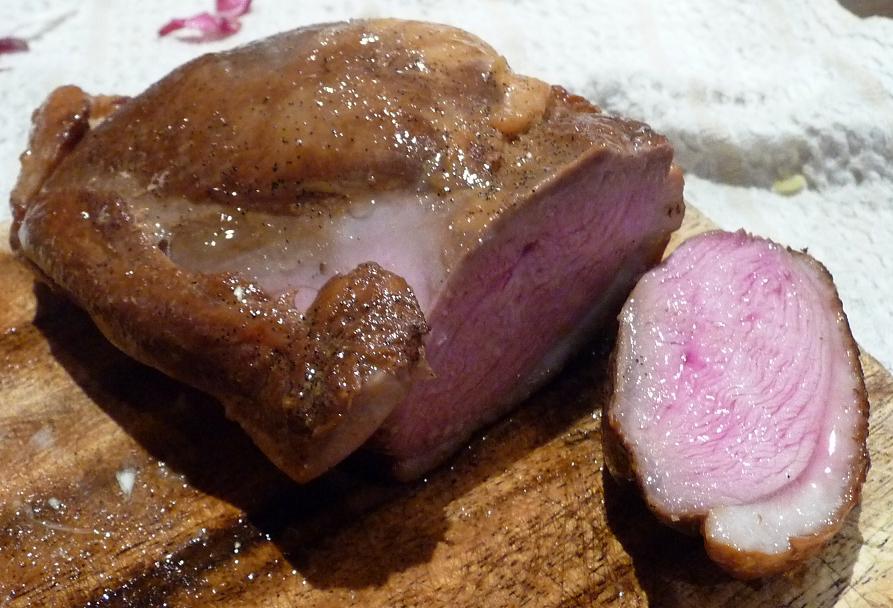
Vanilla and rose tea smoked duck

If Delhi was lacking in clean water and fresh vegetables, it was also lacking in another equally taken-for-granted commodity: clean, fresh air. It is possible my lungs will never forgive me for breathing in the dirty smog, a mixture of burning coal and exhaust fumes and kerosene and wood fires servicing the needs of a city of 14 million people in 1500 square kilometres*.

Breathing in air that felt dirty, oily, tainted: it did not make for much of an appetite.

There is no doubt that there is a link between taste and smell**. We eat with all our senses. Ferran Adria, the mad genius behind El Bulli, is reported to on occasion serve dishes that are accompanied by recordings, (for example, of the sound of the sea) and to spray diners with specially concocted fragrances (like pine wood or autumn earth or sea spray) to enhance their dining experience. But nothing tastes as sweet as clean air.

It’s no wonder that every crowded Delhi corner hosts a chai wallah, dispensing milk-rich and sweetened spiced tea, a steamy aromatic remedy against the encroaching smog.

And no wonder too, that my usually endless craving for smoked and smoky food was also on holiday while I was in Delhi. The smoky, peaty notes in a good single malt whiskey are to be treasured only when the air is crisp and clear and cold. So too the flavour of wok tossed tofu, the incredible heat in combination with sweet soy sauce sending delicate curls of burning sugars around everything. The taste of barbequed spare -ribs, sticky with sweet-hot-sour sauce and infused with smouldering hickory wood chips. Smoked salmon and kippers and bacon and ham and muscles and chipotle chillies and paprika. Bonfires and toasting marshmallows and billy tea and damper and open fireplaces in winter and hot chocolates.

While cold smoking a ham is a) my dream, and b) beyond me in my current location (including our overly sensitive smoke alarm which is deeply committed to the saying that where there’s smoke there’s a fire); hot smoking small portions of this and that is as easy as steaming. In fact, the method is nearly exactly the same.

* At the end of the nineteenth century London was famous for her yellow smog, that gentle pollution which turned the great city golden and allowed her visitors to view her as if through a Vaseline smeared lens. Delhi, taking her turn at industrialisation on a truly epic scale, imitates – and I believe exceeds – the capital of her former colonial occupiers. India has its own path to follow, but I do hope it involves some version of the Clean Air Act.

** This is probably why, whenever I have a head cold, and therefore cannot smell, I attempt to exist on nothing but olives and chillies. Chilli marinated olives for preference, because the salt and heat at least registers on my tastebuds.


Vanilla and rose tea smoked duck

Serves two

1 large wok, with lid
Lots of tin foil
2 duck breasts, skin on
1 cup long grain rice
1 cup rose tea (black tea with rose petals)
1 vanilla pod, cut into 3 pieces
1 cup course sugar
Vanilla salt, optional

Gently score the skin of the duck breast fillets, taking care not to slice all the way through the fat. Rub a little of the vanilla salt if using. Place the duck fillets skin side up on a piece of foil.

Line the wok with four to five layers of tin foil. This is very important, otherwise you will destroy your wok.

Place the tea, rice, sugar and vanilla pod into the wok and stir to combine. Lightly place another piece of foil over the mixture. Cover the wok with the lid and place over a high heat. After about 5 minutes, the wok will be filled with smoke.


Remove lid and place the foil with the duck into the wok, directly on top of the rice and tea mixture. Replace the lid and smoke for about ten minutes (no more).

Heat a grill pan to very hot.

Remove duck from wok, and place skin side down in the grill pan. Cook for 4-6 minutes, until the skin is very crispy.

Remove from pan and rest for 5-10 minutes before serving and rest.

Toss through a salad of citrus and rose petals and shaved fennel, or serve with char-grilled broccoli and mashed parsnips.

Thursday, February 10, 2011

Fresh vegetables poached in clean water

Guide books for western tourists in India have two key and related pieces of advice: drink bottled water. And only eat well-cooked food. Preferably boiled or deep fried. Preferably in front of you. Preferably no meat.

Water is treated in major Indian cities, just not necessarily in the ways that Australian or Americans or the French are used to. So chances are tourists will react a bit adversely. And this links back to the cooking methods – sufficient heat will kill off those minor bugs, so better safe than sorry. And because electricity can be a bit hit and miss (and hence so can refrigeration) meat is best avoided.

Delhi in the middle of winter is pretty cold. Look at it on a map – it’s a long way north of the equator. The Himalayas aren’t that far away. It’s not exactly Birmingham in January, but even if you could safely eat the salad, chances are there wouldn’t be much of it around. It’s not in season.

What you do have on tap is dahl. Lots and lots of dahl. Which I happen to love. Thin soup like consistency, fire-hot on the spicy scale with idlies (streamed rice dumplings) floating in a bowl for breakfast. Thick dark lentils enriched with ghee and cream with whole wheat rotis. Parathas (a whole wheat unleavened bread) stuffed with thick paste- like dahl. All good. Breakfast, lunch and dinner.*

But the butter and oil and carbohydrates and general stodge takes its toll. Lightly steamed vegetables and salad and fruit and a really good steak** starts to have an appeal after a week or so.

* I need a break before I can recreate these in all their glory.

** I know, cows are sacrosanct in India. But when a girl craves steak she craves steak. Good, medium rare, organic heritage-breed eye fillet steak. With little criss-crossed charred marks and a melt-in-you- mouth texture.

Vegetables poached in beurre monte

Serves two people desperate for fresh vegetables

1 litre water
60 gm butter
4 baby carrots, peeled and cut in half length ways
4 brocollini stalks
1 fennel bulb, sliced into thin wedges
2 small yellow button squash, cut into thin wedges
10 cm piece leek, sliced lengthways into thin strips
1 small zucchini, sliced into batons
100 gm green beans, top and tailed

In a large deep fry pan, bring 1 litre of water to a rapid boil. Reduce heat to a simmer, whisk in butter, half a teaspoon at a time until emulsified (this make a very thin beurre monte). Add a teaspoon of sea salt flakes.

Bring back to the boil. Add brocollini and carrots. Simmer for about 3 minutes. Add remaining vegetables and simmer for another 3 minutes. Remove vegetables to a warm plate. Scatter with chopped herbs, sea salt and cracked pepper to taste. Serve with char-grilled steak.

For a simple sauce for steak, reduce remaining poaching liquid by half, and then whisk in approximately 1 tablespoon butter, half a teaspoon at time and a teaspoon of Dijon mustard. This should result in a thickish silky sauce, to be spooned over a perfectly cooked eye fillet.

Wednesday, December 29, 2010

Raspberry and rosewater sorbet

Raspberries: fresh picked, sun ripened, deep crimson. They smell like fairy-floss, their sweetness giving only the merest hint of underlying tartness. I rarely cook with raspberries because it is far too satisfying to eat them in their natural state without interference. Their colour reminds me of sunburn and they taste like heaven and explode like midsummer in the mouth.

This year, like last year, Little Chocolate Flavoured P- arranged for a ridiculous quantity of fresh raspberries to be picked for Christmas lunch. My share – a half kilo of pure, uncut, just picked summer magic.

Like the roses to which they are related, rubus idaeus are not native to Australia, where this common European bramble is a luxury summer fruit (actually, there is a native Australian raspberry but it is not commercially grown and the fruit is not commonly available. Blackberries, on the other hand, are so abundant they are considered a noxious weed and cannot be harvested in the wild in case they have been subject to poison extermination spraying).

My childhood, which featured peaches and plums and apricots negligently and gluttonously consumed whilst perched in the branches of the respective trees was strictly limited on the berry front (with the notable exception of mulberries, as both my friend Louise and I had truly enormous mulberry trees, perfect for climbing and straining school uniforms).

And yet the mere mention of raspberries and I am four or five again, scrawny and corduroy-pinafore wearing, Strawberry-Shortcake knee-high socks and wispy never-neat hair.

The kitchens of Brambly Hedge were full of activity. Cool summer foods were being made. There was cold watercress soup, fresh dandelion salad, honey creams, syllabubs and meringues. The young mice had been up early to gather huge baskets of wild strawberries.*

It is the literature, not the reality, of my childhood that induces these flashbacks. With the iconic bramble borders, which shifted with the seasons – full-fruited or blossoming or bare and sprinkled with winter snow: Brambly Hedge. It is no real mystery that the books of Jill Barklem were so influential: cute and pink and floral, the beautifully illustrated stories of the little woodland dwelling community of mice, guided by Lord and Lady Woodmouse (and their slightly naughty daughter Primrose), with its dairy and flour mill, could not have been better targeted at small and dreamy little girls.

And most importantly: they featured meticulously researched exotic fairytale foods like roasted chestnuts and elderflower syrup and crabapples and sugared violets and bramble jelly and acorn coffee. Although all real (and apparently tested) traditional English recipes, they seem to me just as fantastic as the toffee pops of Enid Blyton’s The Magic Far Away Tree and the pepper-imps and chocolate frogs of JK Rowling’s Harry Potter. All these books shared nothing in common with what was normal in my childhood, like vegemite or kangaroos or summer bushfires or funnel web spiders.

In a blurring of make-believe, nostalgia and hard botanical fact, nothing is more obvious that the pairing of raspberry and roses, heady rosewater scented sugar syrup and pureed fresh raspberries, churned into a delicate and icy floral dessert.


* Jill Barklem Brambly Hedge Summer Story William Collins Sons & Co Ltd 1980


Raspberry and rosewater sorbet

1 cup castor sugar
1 ¾ water
Juice of one lemon
2 tsp rosewater
500 gm fresh (or frozen) raspberries

Heat the water and sugar together in a heavy bottom saucepan, stirring until the sugar dissolves.

Cool for half an hour or so, add the rosewater, lemon juice and raspberries and puree with a bar-mix (or decant into a blender and pulse).

Strain mixture into a bowl through a mesh strainer (to remove the raspberry seeds).

Leave to cool. Taste (if too sweet, add a little more lemon juice).

Decant mixture into an ice-cream machine and churn according to the machine’s instructions. Serve as soon as a soft sorbet consistency forms (or settle it he freezer for an hour or so until firm enough for your liking)

If you don’t have an ice-cream machine, you can freeze in a loaf tin in the freezer – take out every hour or so to break up the ice crystals forming by beating with a fork. Once the mixture hardens, scrape with a fork into a pile of shaved ice and serve as a granita (as it can be difficult to get the same smooth consistency as a sorbet without a ice-cream churn).

Scatter with mint or pistachios or sugared violets or rose petals to serve.

Makes 1.5 litres

Friday, December 24, 2010

Summer Christmas versus Winter Christmas (what my little brother is missing)

Last Christmas I made (amongst other things) gravlax. A side of salmon, cured in sugar and rock salt and dill and juniper berries and gin. My brother, who shares my affinity for Bombay Saphire, proceded to eat the gin soaked curing paste as I brushed it off, preparing to thinly slice the moist, sweet bright pink fish. Unsurprisingly, it made him ill.

I miss him.

Soon to be professor-doctor-clever-pants in the world's most obscure and impractical discipline, he lives in Oxford, where it is very cold and people ride bicycles. He was here, with me, last year for Christmas. This year is another year when we are not spending Christmas together.

I miss him.

Not that he is much help at Christmas (although his bacon-sandwich making capabilities, possibly his only real culinary triumph, are to be respected on Boxing Day and New Year's Day, when fried breakfast food is generally welcomed). He does have an eye for Christmas decorations (insisting on a real tree last year, and hence improving the Christmassy-ness of the whole occassion). And he does know the words to most carols, even if he doesn't always sing them in tune (an allegation he would no doubt deny).

Last year (for a number of reasons that now seem ridiculous) I experienced a severe case of 'being-overwhelmed-at-Christmas', which manifested in tears about two barbeequed chickens (best not to ask). My brother just being here, in all his goofy, idiotic, and vaguely dada-esque way made it just a bit easier to cope. (How this involved purchasing pale blue silk socks is a mystery). We ate half a kilo of fresh raspberries to help us deal with the whole situation.

I shouldn't worry that he'll be lonely at Christmas (he has more facebook friends than I have recipe clippings, which is to say, a great many). He will be having the white Christmas I can only ever dream about. But he isn't here, and he'll miss all the summer fruit, the cherries, the cold beer and the cricket in the backyard. He'll miss the sunburn and the gin and tonics and the pimms cups and the ice-cream from my new ice-cream machine. He'll miss having people around him who have known him forever. If he mopes unreasonably, I won't be there to tell him to stop being an idiot. He'll miss me.

Merry Christmas.


Christmas Salad: roquette, peaches, buffalo mozzarella and prosciutto

Slice two very ripe yellow peaches into thin wedges. Toss with two cups (ish) of wild roquette. tear six slices of prosciutto and toss through with the peaches and roquette. Arrange on a plate. Break one ball of fresh buffalo mozzarella over the top, drizzle with olive oil and eat in Australia at Christmas time.

Serves 2

Friday, December 17, 2010

Spicy almond biscuits to warm the coldest of hearts

There are bronze stars and red glitter-spangled baubles hanging from the ceiling above my desk at work. Silver stars and snowflakes and globes are strung from the banisters in my apartment and attached with paper clips to the small pine tree in the corner of one room. The house is filled with the scent of cinnamon and sugar.

Last night after yet another bellini* themed Christmas catch-up with yet another indispensible friend on my way to cook dinner for another different and equally valuable loved one, I stopped to buy a small Christmas gift for my mum. With a backpack full of dried fruit and nuts and Christmas cheer, a handbag containing frozen broadbeans, and an accumulation of several weeks worth of Champagne, I perhaps was not in the best frame of body or mind to browse in a crowded, tiny shop full of small gift type things.

A beautiful young man set aside a small something whilst I searched for additional perfect lovely things. I love Christmas, I hum carols, I adore that the world pretends to be shinier, more beautiful, more bearable for just the smallest window of time. To my very great shame, last night I got fed up and frustrated and walked out the shop before purchasing these gifts.

And the boy, who had so helpfully found the very last stocked item of a hard to find special something, ran out of the shop after me. He had already wrapped my pieces in Christmas paper. He was sorry it was so busy. He explained that it was Christmas. As if I didn’t know.

I couldn’t have felt more like Scrooge if I tried**. I walked back into the store.

This morning I made cookies. Something I have been meaning to do for weeks. To decorate the tree. To give as gifts. To just have the house smell like Christmas baking and holidays and love.

And this afternoon, I packed a brown paper bag with tissue paper and biscuits. I walked back up the street, intending to deliver them to the manager of the store I been so well and undeservedly served the night before. An anonymous gift. Except, the very same man who had been so patient the evening before was standing out the front of the shop. And he recognised me.

And there I was, with a bag of cookies. I explained that it was Christmas. As if he didn’t know. I couldn’t have felt more like Scrooge if I tried***. He walked back into the store. With the cookies.

* Fresh white peach puree, peach schnapps, prosecco.
** “He carried his own low temperature always about with him; he iced his office in the dog-days; and didn't thaw it one degree at Christmas.”
Charles Dickens A Christmas Carol
*** “And it was always said of him, that he knew how to keep Christmas well, if any man alive possessed the knowledge. May that be truly said of us, and all of us!” Charles Dickens A Christmas Carol


Almond spice biscuits

200 gm raw almonds (no need to have blanched ones, the skins are fine)
1/3 cup icing sugar
1/3 cup castor sugar
¾ cup flour
2 egg whites
3 tsp cinnamon
1 tsp ground ginger
1 tsp ground cardamom
½ tsp ground black pepper

Heat the oven to 150ºc. Line several baking trays with greaseproof paper.

Put nuts in a food processors and pulse until the nuts are finely ground. Add everything else and pulse to combine.

Gather together into a ball. Roll out between sheets of plastic wrap (the egg white make it quite sticky).

Cut out with cookie cutters. Gather the scraps and roll out again, until no more dough is left.

Bake for about 20 minutes. Cool on a wire rack.

Decorate and share.

Friday, December 3, 2010

The rosemary thief, zucchini ribbons

Spilling over the footpaths through wrought-iron fences, overgrown with Austin roses and lavender: rosemary. It is unkempt, scraggly, rough, woody, never pruned or disciplined or watered. This time of year is filled with the scent of jasmine and honeysuckle and roses and the sharp, piney smell of crushed rosemary, oils released on the wind and as you brush past and step on the ambushing bushes.

Grown first on the Mediterranean coast, the name rosmarinus means dew (ros) of the sea (marinus)*. This refers to the fact that rosemary can get by on the smell of an oily rag**, that is, the moisture carried from the sea spray to the sandy soils it spreads its roots into.

Set against a backdrop of artful and not so artful graffiti and aerosol art, bluestone gutters, warehouse conversions and factories and done-up and not-done-up terrace houses, the square mile that is mine is a mixture of old bones and new money and no money, designer and vintage and plain old second-hand. Cottage gardens and lace curtains and polished floorboards and discarded syringes and nightclubs and a brothel on the corner. And in the tiny front gardens of rental houses and trendy laneway offices, the plants that thrive on neglect, that have been in the ground since Federation (or maybe the sixties or seventies) have become wild, the wiry odd drought loving plants of the Mediterranean. Parsley, sage, rosemary and thyme.

Clad for a break-and-enter or maybe just random street violence, I execute my vaudeville burglar impersonation. The conspiratorial glance over the shoulder. The nonchalant sidle against the corner of the apartment block. The overly innocent stroll ten, twenty metres down the street***. The exaggerated feigned dropped item. Then, quick as a flash, the snicker-snack. The mass of forest green reduced by inches. The softest, newest tips slipped deep into the pocket of an apron or handbag, or in one brazen instance of daylight robbery, discreted up inside the sleeve of my anorak.

* Ian Hempil, Spice Notes p. 338. I am slightly disappointed with the Larousse entry on rosemary which indicates the etymology of rosmarinus to be ‘rose of the sea’. I am hoping that some enterprising Classics scholar (cough,νωοφ, you know who you are) may adjudicate on the matter.
** This is a particularly, and quintessentially, Australian saying. To say that something runs on the smell of an oily rag means it can survive on a bare minimum. One could use the phrase to describe a particularly fuel efficient ute, for example.
*** I would innocently whistle, but alas, I am incapable. Of whistling. Not of innocence.


Rosemary zucchini ribbons

Serves four as a side

3 tbsp olive oil
2 anchovy fillets in oil (or more to taste)
1 tbsp garlic, finely chopped (about 4 cloves)
1 tbsp fresh rosemary finely chopped
3 medium sized zucchini (courgettes) sliced lengthways into thin ribbons (about 400 gm zucchini)
Sea salt
1 tsp soft tips of rosemary to serve

Heat the oil in a large fry pan. Add anchovy fillets and stir until dissolved. Add garlic and rosemary and stir until garlic is soft.

Lay the ribbons of zucchini in the pan, cover with a lid and cook for about 3 minutes, or until the ribbons are starting to brown. Turn over, and cook for another 2 to 3 minutes. Taste, and add sea salt if necessary.

Scatter with rosemary tips to serve. Good hot and at room temperature.

Saturday, November 27, 2010

What is a waldorf anyway, a walnut that’s gone off?*

New York city: the Waldorf Hotel. Circa 1893-1896. Oscar Tschirky. Swiss. Not a chef.

Apple. Celery. Mayonnaise. Later addition: walnuts.

The Waldorf Salad.

Its genius lies in its simplicity. Like coleslaw, so very, very dependent on the quality of the ingredients. Like coleslaw, so easily and so frequently the victim of grave injustice.

The key is crunch and bite. The crisp clean taste of very, very fresh celery. Inner stalks only, with the tender pale green leaves retained for garnishing. Tart apples, preferably peeled. Granny Smiths are perfect, that hint of sourness to their juicy sweetness. And walnuts. Toasted. Some puritans insist that they are also peeled. I have never found this necessary.

Nothing is more important than using fresh walnuts. Or conversely, nothing is more rank than the taste of rancid nuts, the oils sour and foul. My preference is to purchase mine from a specialist nut-purveyor at the market. I know that they will be correctly stored and have frequent turn over. In a pinch I will buy them in vacuum sealed packets, sold in the supermarket next to the dried herbs and spices and sugars and salts (understandably my favourite aisle in the dreaded supermarket).

And then there is mayonnaise. At which point I give up. I am overly sensitive to what I consider a crime against both condiments and salad dressing: the mayonnaise jar. How a sauce so beautiful has become something so unredeemably fetid I cannot comprehend. I can usually find it in me to be at least a little understanding of food choices that differ from my own, but mayonnaise? Like the ungodly offspring of cream and industrial solvent, industrialised, commercialised, commodofied, squeezy-bottle mayonnaise has no place in the hallowed grounds of the waldorf salad.

I find homemade mayonnaise gentler and richer than any store bought jar (and I do grudgingly admit, some are better than others, and indeed almost edible). It is easier too, to tailor one’s dressing to the salad. A hint of mustard, a little walnut oil, thicker rather than pourable, the better to bind the ingredients without drowning them. A good discipline to learn: a basic emulsification, the miracle whipping of eggs yolks and oil. Less recipe and more technique.

And like every canonical recipe, the Waldorf Salad suffers from the non-canonical reinterpretation. So my secret: soak the apples in apple-cider vinegar for 15 minutes to enhance the sweet-and-sour qualities. A hint of cream cheese in the dressing. And slivers of shaved mouse-tailed pink radishes, hot and peppery and a pop of colour.

* Faulty Towers “Waldorf Salad”, 1979


Waldorf-ish Salad

Serves four as a side or light lunch

2 Granny Smith apples, peeled, cored and cut into 1 cm dice.
1 ½ cup celery, cut into 1 cm dice
1 tbsp apple cider vinegar
¼ walnuts, toasted (roast in a moderate oven for about 6-8 minutes)
½ cup mayonnaise (approximately)
1 tsp cream cheese (optional)
6 breakfast radishes, thinly sliced or shaved.
1 tbsp small celery leaves
1 tbsp extra toasted walnuts

Mix the apple and celery with the apple cider vinegar in a non-reactive bowl (ie, not metal) and leave sit for about ten to fifteen minutes (meanwhile, make the mayonnaise).

Mix the cream cheese (if using) into a quarter cup of mayonnaise, then toss with the apples, celery shaved radishes and toasted walnuts. If necessary, add extra mayonnaise until the salad is coated but not drowning.

To serve, scatter with extra walnuts and celery leaves.

Great with chicken or turkey.

To make mayonnaise:

2 very fresh egg yolks (keep the eggwhites for macarons or meringue or soufflé or something equally delicious. They freeze well too).
1 tsp Dijon mustard
2 tsp vinegar (white wine vinegar or tarragon vinegar)
250 ml oil (any kind of oil is fine. I like olive oil, which can have a strong taste. Sunflower oil or canola oil also works just fine)
Sea salt and white pepper, to taste

Make sure all the ingredients are at room temperature.

In a large non reactive bowl (I use pyrex for just about everything) beat the egg yolks with the mustard and 1 teaspoon of vinegar. Beat until smooth and creamy looking.

Drizzle in 1 teaspoon of oil, and beat until fully incorporated. Drizzle other teaspoon, and beat until fully incorporated. Continue this process, drizzling and beating in tiny spoonfuls of oil until about half the oil is combined. Then, drizzle the remaining oil in a very thin steam, beat constantly until the mayonnaise is the desired consistency. Taste, and add salt and white pepper if needed.

Can be made with a wooden spoon or hand whisk or even electric beaters. The trick is the very slow incorporation of the oil into the egg yolks.

Sunday, November 21, 2010

Tacos. Grown up finger painting for the mouth

Growing up, tacos were always a big deal in our house.

My parents owned a particularly lovely carved serving platter, made, I think, from the wood of a coconut palm, in the shape of a leaf. The smooth deep bowl of it was divided in to four smaller hollows, a perfect home for keeping the various taco fillings separate and yet all together. It was used almost exclusively for taco nights.

Tacos-for-dinner was a production, a matter of great ceremony and extra fuss. Tacos were purchased as ready-made corn-chip shells in a taco-kit box, to be crisped in oven for ten minutes prior to eating. It was a great test of skill and nerve to neatly stand each shell vertical, fold-up, balanced on the curved edges like little clog-clad feet. Important not to forget to remove from the oven, lest the shells overcook (or as I remember once, start to smoke).

The boy child and I did not eat tomatoes, capsicum, avocado or coriander. What we did eat was grated Kraft cheese, grated carrot, shredded ice-berg lettuce, sour-cream, sweet (store bought!) salsa and pan fried beef mince. Taco night embodied semi-rural Australia, which is a long, long way from Mexico.

And there was an art to preparing the taco: an intricate and personalised order in which the ingredients were added. My preference: meat, salsa, cheese, carrot, lettuce, sour cream. This, for me, was the only and most logical way to construct the meal: the salsa seasoned the meat, the warm meat melted the cheese, and the carrot (a vegetable able to consumed with equal enjoyment cooked or raw) acted as a thermal buffer, protecting the lettuce from wilting. Sometimes, towards the end of a taco eating contest (a contest between my brother and I, a contest between my present and previous consumption record), the final taco was snapped in half, with the messily discarded jumble of previous taco fillings scooped up and sandwiched in between the broken shell.

Tacos were fun, gluttonous, sweet and salty and crunchy and cheesy. It was hands on, messy, full of sharing and hording. It was impossible to finish the meal with anything other than mess smeared across our faces and dripping down our elbows. Tacos always preceded rather than followed a bath.

The gap between the taco-kits of my childhood and the Mexican tacos which pre-date European arrival is immense. Perhaps the only commonality is the yellow-corn-colour of the cardboard textured hard-shells.

Real tacos, homemade soft corn or flour tortillas, salsa fresh with coriander and lime, smoky marinated chicken or fish, are a revelation. If anything, the evil glee that making a mess while eating inspired is multiplied exponentially, as is the pleasure of a riot of flavours and delight of assembling it just so. I have flour in my hair. I have somehow managed to spill the juice of half a lime directly into my right hand pocket. I have dough stuck to my knuckles and finger nails. Coriander-chilli-ginger-garlic-lime-zest paste smeared along the inside of one forearm. And that was before I even started eating.


Soft corn-and-flour-tacos with lime and coriander chicken, salsa and roasted tomatoes.

Serves four

16 corn and flour tortillas (see below)
Lime and coriander chicken (see below)
Salsa (see below)
Roasted tomatoes (see below)
Sour cream

To serve: add a spoonful of each component to the warm soft taco in the order that makes the most sense to you. Fold in half and make a mess.


Corn and flour tortillas:

I realise that I am a novice when it comes to tortillas, and that usually you make either corn or flour tortillas, not a combination of both. I understand that in taco-profilic countries like America and Mexico there are things such as tortilla presses and more than one brand of maize flour. People have practice and opportunity there. Still, this beats the pants off buying taco-kits, and adding wheat flour to the maize flour helps the dough keep its elasticity.

1 cup maize flour (not corn flour, and not polenta. Maize flour).
1 cup wholemeal plain flour
½ tsp salt
1 ¼ warm water
1 tsp oil

Mix the flours and salt together. Make a well, and add 1 cup of the water and the oil. Mixed with a hand, and as the dough starts to come together, add the remaining water (as needed) – you should end up with a soft, warm slightly sticky dough. Knead lightly until just smooth (not more than 5 minutes). Break the dough into 16 ball shaped pieces (keep them covered with plastic wrap whilst working each ball).

Place a ball of dough between two sheets of baking paper and roll out with a rolling pin until about 20 cm in diameter. Peel one piece of paper away from the tortilla, leaving the other attached. Repeat for the remaining balls.

Heat a non stick frying pan to hot, brush with a little oil.

Place the tortilla paper side up in the pan – as the tortilla starts to cook, the dough will dry and the paper will peel away (this takes about 1 minute). When the paper is removed, turn the tortilla over, and cook the other side for about 30 seconds. Repeat with remaining dough. Set aside and wrap in a clean tea-towel to keep warm.


Spiced Chicken

In her book Fire, Christine Mansfield gives a beautiful recipe for Mexican chicken and lime soup. This recipe draws on the ingredients that make that soup so fresh and vibrant.

500 gm chicken breasts, sliced into thin stir fry strips
1 tbsp oil
¼ cup fresh coriander stems or leaves
1 tbsp finely grated ginger
2 cloves garlic
1 long red chilli (medium heat)
1 tbsp chopped red onion
1 tbsp chopped green onion
1 very ripe tomato
1 tsp finely grated lime zest

Puree the garlic, ginger, chilli, coriander, tomato onions and lime zest until a thick paste forms. Heat the oil in a large fry pan, add the chicken strips and paste. Cook over a high heat until the chicken is cooked through the paste is thickened. Set aside.

Corn and Capsicum Salsa

1 cob corn, kernels removed and blanched.
½ red capsicum, cut into 1 cm dice
½ yellow capsicum, cut into 1 cm dice
1 avocado, cut into 1 cm dice
½ cucumber, cut into 1 cm dice
¼ cup green spring onions, cut into 1 cm lengths
1 tbsp red onion, cut into 1 cm dice
1 tsp finely grated lime zest
Juice of 1 lime
1 cup torn coriander leaves
½ tsp sea salt

Toss all ingredients together.

Roasted tomatoes

1 punnet cherry tomatoes
½ tsp sea salt
½ tsp cracked black pepper
½ tsp smoked paprika
½ tsp castor sugar
1 tsp (approx) balsamic vinegar
1 tbsp olive oil

Heat the oven to 180ºc.

Cut the cherry tomatoes in half. Add all ingredient to a baking dish and toss to coat. Cook for about ½ hour or until the tomatoes are starting to caramelise but still retain their shape.