Showing posts with label winter. Show all posts

Tuesday, August 31, 2010

Cinderella moment: roast pumpkin and the pig


I am not all that fussed about pumpkin. I grew up relatively untouched by pumpkin. My father, a man who religiously grew choko vines for my entire childhood and expected me to eat them, boiled to a watery nothingness, was not all that fussed about pumpkin. If the stories are to be believed (and to be fair, few people remain available or willing to attest to their veracity) he grew up with an adamant refusal to eat pumpkin, boiled to a watery nothingness. And there is some indication that at some early stage he was most villainously deceived with ‘mashed yellow potato’.

We did not eat pumpkin in our house when I was a child. Lack of exposure led to lack of familiarity which in turn led to a benign neglect of pumpkin in my life.*

Halloween, harvest festivals and Cinderella also did not feature in my formative years, and so my lack of pumpkin exposure in the home was not challenged by a broader desensitisation via popular culture. A home-ec incident involving a Queensland blue pumpkin, a blunt knife and the tip of the middle finger on my left hand cemented my general impression that pumpkins and I moved in very different circles.

Had I , as a young child, seen the streets of Hoboken, New Jersey, in mid October, the steps of brown stone terraces artfully lined with bright orange spheres, here and there delicately and expertly carved into hobgoblin faces of glee and terror, I may have been more accommodating and more curious. I may even have been utterly charmed, as I was when well into adulthood I experienced the cultural grip of Halloween for the first time.

But as it was I came to pumpkin in a mechanical and mundane way. It was just another relatively common vegetable that is predicably very nutritious, cheap and colourful during the dreary winter months. It is good for you. Vitamin A and vitamin C. Potassium. Magnesium. Other technical sounding components. It’s a kind of melon, and like melons it has a ridiculously high water content (which makes it fabulous for soup, but certainly explains it’s tendency to become watery). It’s vaguely sweet, roasts nicely, purees well and looks a bit artistic in the middle of table. I made soup and curry and purees and even pies, sweet and savoury. And felt virtuous but never thrilled.

Then the inevitable occurred.

I wrapped it in bacon.

The home-cook’s fairy godmother.


* Which is utterly inconsistent with my near obsession with Brussels sprouts, another subject of childhood deprivation. I don’t get it either.


Prosciutto wrapped butternut pumpkin with thyme and honey

Serves 4-6 pumpkin eaters

1 whole butternut pumpkin, peeled, de-seeded and cut lengthways into wedges – between 10-12 wedges
1 tbsp melted butter
1 tbsp honey (use a good wild honey. It has more flavour)
1 tbsp boiling water
1 tsp thyme leaves, finely chopped
12 sprigs thyme,
12 slices prosciutto, each cut in half lengthways
Salt and pepper

Pre heat the oven to about 200ºc. Oil a baking tray.

Mix the honey with the butter and boiling water. Brush each pumpkin wedge with the honey mixture. Scatter with chopped thyme, salt and pepper. Wrap each wedge with strips of prosciutto, like a candy cane. Arrange on the baking tray.

Brush over any remaining honey. Arrange thyme sprigs over the pumpkin wedges.

Place in the oven and cook for about 30 minutes or until cooked (a tooth pick or skewer will insert easily when cooked). Cover with foil if the prosciutto starts to become too brown.

Tuesday, August 3, 2010

Eats roots and leaves: nose-to-tail celery and celeriac soup*

Wastefulness. At one end of the input-output spectrum we throw away millions of tonnes of perfectly edible food every year.

At the other end of the spectrum, we limit, and therefore waste, the options available as food. Our environmental impact is such that species are become extinct at an alarmingly exponential rate (they ate dodos people. And don’t even get me started on the implications of bee extinction**). In terms of food production and consumption we are also voluntarily limiting the variety of species that we chose to eat***. And even more so, we are choosing only to consume a very small part of those species that we do choose to eat.

Homo sapiens, the smart men, need to eat smarter. Nose-to-tail eating is a brilliant slogan for us carnivores. ‘Eats roots and leaves’ captures this for the herbivores among us. It’s true that not every part of every plant is edible. Some are in fact harmful. But beetroot leaves, broccoli stalks, grape vine leaves, and pumpkin seeds – all edible. Orange rind and pineapple skins make beautiful marmalade. Watermelon rind can be turned into pickles.

And pretty much every part of celery can be devoured.

Most of us are familiar with the stalks – the crunchy light green part, great with hummus or peanut butter (that may be my particular fetish ...). Wash, cut, throw away the leaves, right?

Alternatively – eat it all. Young celery leaves are lovely in salad. Older leaves can be blanched like English spinach or oven dried as crunchy snacks or even powdered for a concentrated celery flavoured dust. Even the tiny seeds are edible. As is the root.

Celeriac is a knobbly, bulbous root of a variety of celery. It has a subtle celery flavour and can be eaten raw (for example, julienned in French remoulade, a kind of mustard mayonnaise salad), roasted or fried (a little like potato, but less starchy) or steamed and pureed (try: half potato, half celeriac, significant amounts of butter, delicious).

Which all leads to soup: with a light creamy texture and a fresh celery taste, it is all the comfort of winter with all the promise of spring. Using every part of the celery plant.

* For those with a one track mind, the incorrect insertion of a comma can make all the difference. See Lyn Truss’ excellent work on gramma, Eat, Roots and Leaves

** In a nutshell, bees fertilise flowers. Fertilised flowers grown into seed producing fruit. See producing fruit are a) edible, and b) the basis upon which other flower-producing plants grow. Fewer bees means reduced fertilisation, which impacts on crops. Bees are a big deal for the farming sector. And bees are very sensitive to environmental change.

*** This is more complicated, because on one level this is being limited for us by the agricultural and retail sectors, but en masse, we-the-human-race are limiting our choices.


Thick celery and celeriac soup

1 bunch celery
1 brown onion
1 garlic clove
100 gms finely chopped bacon (optional)
1 celeriac (about 500g), skin removed and roughly chopped
1 lt vegetable or chicken stock
2 small potatoes, peeled and cut into ½ cm dice
Salt and pepper to taste
Sour cream to serve

Celery powder (in advance)*

Preheat oven to 50ºc.

Remove celery leaves. Spread out on an oven tray, bake in oven for around 45 minutes, or until dehydrated. When completely dry, blend in a food processor until finely powdered. Remove any spiky bits of stalk. Store in an airtight container (as with other dried herbs and spices, usually good for about 6 months).


Celery and celeriac soup

Finely dice the onion and 3 celery stalks (eat remaining stalks as a snack with peanut butter or hummus or tzadziki) and mince the garlic.

Combine with bacon in a large heavy based saucepan, and cook over a low heat until the onion is starting to soften. The low heat will melt the bacon fat – if not using bacon, add a teaspoon of olive oil.

Meanwhile, in a separate pot, blanch the potato dice in boiling water until cooked through (about 5-10 minutes).

When the onion is soft, add the celeriac and half the stock. Bring to the boil. Once boiling, add half the remaining stock and continue to cook until the celeriac is soft enough to smash with the back of a spoon. This takes about 25 minutes.

Blend the soup in a food processor or with a bar mix until smooth. Add salt and pepper to taste.

Return to saucepan and add remaining stock. If the soup is too thick, add a little water. Stir in the cooked potato and heat through.

Serve with a dollop of sour cream and a generous sprinkling of celery powder.

* I started making celery salt and got side-tracked - and voila, celery powder.

Thursday, July 22, 2010

Oxtail ravioli: short cuts versus cheap cuts

Idiosyncratic is probably a good word to describe someone who lovingly and painstakingly slowly braises, strains, cools, shreds and portions two kilos of oxtails over seven hours, and then uses frozen wonton skins as ravioli wrapping.*

Idiosyncratic is also a pretty good description of someone who sees this same lengthy and messy exercise as a somehow saving time.

Idiosyncratic, too, to spend all this time and effort to create what is essentially oxtail soup despite having overwhelming memories of avoiding at all costs an offering of oxtail soup as a child.

Consistency is the sign of small mind.

On any animal, the harder working the muscle, the tougher it’s going to be. On a cow, the hardest working muscle is always going to be a tossup between the cheeks (constant chewing) and the tail (constant flicking).

The lazy muscles result in incredibly tender cuts of meat, the most well known being filet (aka tenderloin, fillet, eye fillet etc - which is taken from along the spine). Even in organically reared, grass-fed, happy cows, fillet is a little bland in flavour. Quick-cooking, oh-so-soft, brilliant raw for steak tartare and Carpaccio. It’s a trade-off: texture versus taste. It’s a premium cut. Very expensive.

Because people and supermarkets have rocks in their heads tender cuts are almost universally preferred (consistency, as I said, is the sign of a small mind). And yet the idea of their being ‘premium cuts’ strikes me as a bit silly. It’s all from a cow, right? If we’re going to kill the beast, we may as well eat more than the softest quarter of it.

Particularly when the real flavour is found in the hard working ‘economical cuts’. Bring on the skirt steak and the shin. Pork and lamb necks. Beef cheeks. Hocks and brisket. And oxtail.

It’s cheap. And packs a punch of flavour. But it is often sinuous. It’s attached to tendons and bones and often has marrow in its near vicinity. All good for flavour, if a little tough.

Time to work the magic of braising.

Any idiot can burn a fillet steak. But it takes an even bigger idiot to screw up braising. The genius of braising is that there is no genius required. At its most very basic, a braise is a cross between a poaching and a steaming process, with meat (or vegetables) first seared / browned and then partially covered in liquid, covered and cooked over a very low heat for a long time. And the beauty of it is that whilst you can undercook it, it’s almost impossible to overcook it. It takes a long time, but it’s not really time consuming. Mostly it’s just a matter of being vaguely around to make sure it doesn’t bubble over or run dry or that the gas doesn’t go out.**

Slow cooking oxtails results in a sticky, gelatinous mess of soft-as-butter dark fibrous meat. Rather than serving with equally rich creamy mashed potato or risotto, shredded, wrapped up in ravioli sheets and poached in consommé made from the left over strained braising liquid, wine, water and bottled tomatoes, sprinkled with a little gremolata, zesty and garlicly and fresh, the resultant soup is light and lavish, meaty and yet not too indulgent.

So the trade off for cheap and flavourful is that is takes forever. But the short cut is that you can make it all in advance, in bulk, and freeze it. Straight from the freezer? Cooks up in about ten minutes.


* The frozen wonton wrappers have as the listed ingredients: flour, eggs, salt. That’s it. This, I think, is pretty good. Plus they’re the right size, thinness and so terribly convenient. And I don’t have a pasta machine. Pasta dough is easy enough to make (it has flour, eggs and salt in it). But you try rolling it with a rolling pin.

** I’ve heard it’s even more foolproof with a kitchen gadget known as a crock-pot.


Oxtail ravioli* in tomato consommé

Serves 8

2 kg oxtail pieces (or other beef on the bone, like osso buco or short rib)

Plain flour (seasoned, for dusting the oxtail)
¼ cup oil olive (roughly)
2 brown onions, diced
2 large carrots, diced
375 ml dry red wine
500 ml veal or beef stock without salt (or water)
Herbs – 2 bay leaves, sprigs of rosemary, thyme, oregano and parley
2 pack frozen wonton wrappers or ½ kg fresh lasagne sheets (bought or homemade)
1 egg, lightly beaten

Dust oxtail pieces with flour (shake). Heat a couple of tablespoons of the oil in a very large saucepan, and cook the pieces in batches until brown all over.

Heat another few tablespoons of the oil and add the onions and carrots, cook until starting to brown.

Deglaze the pot with the wine, stirring to remove any pieces stuck to the sides of the pot. Bring to the boil and cook until the alcohol is cooked off (a couple of minutes).

Add the oxtail pieces back into the pot, add the herbs and stock (it should cover about ¾ of the meat and vegetables. Cover with a parchment lid, and then place the pots lid securely on top. Place over the very lowest heat and gently cook for about 4 hour (it should be just barely a simmer, remove the lid if it is cooking too rapidly). By this stage the meat should be falling off the bones (if not, cook a little longer).

Remove the oxtail pieces, and when cool enough to touch, shred the meat and discard the fat and bones.

Strain the braising liquid and reserve. Add the strained vegetables back in with the shredded meat (discard the herb stalks and bay leaves).

Taste the meat and vegetable ravioli filling, and add salt and pepper to taste.

Place 30 wonton wrappers on the bench, brush the edges lightly with egg wash. Place a small spoonful of filling in the centre of each, and then place another wrapper on top, pressing to seal. You can freeze, refrigerate or cook at this point.

To cook, add to consommé and cook until the wrappers are cooked and the filling is hot. When frozen I just throw then into boiling water frozen and cook.

Serve in a bowl of tomato consommé, sprinkled with gremolata and parmesan cheese.

Tomato consommé

Reserved strained braising liquid.

For each 250 ml braising liquid:

1 tin chopped tomatoes (no added salt or added anything is preferable)

500 mls water (or half water, half red wine)

Boil all ingredients together until reduced by half. Strain. Season. Pour over ravioli to serve.

Gremolata

Traditionally, this is made with equal parts finely chopped parsley, finely grated lemon zest and minced garlic.

I have been known to use grapefruit zest, minced olives, and capers as substitutes and enhancements ...

* Based on a recipe by Elizabeth Egan and Domenic Pipercelli of Becco restaurant in Melbourne published by Australian Gourmet Traveller.

Monday, July 19, 2010

Eating the Winter garden

My mum’s garden is the source of all things tomato during summer. But during the winter months (and the cold that I am only just starting to come to terms with) she grows the softest, sweetest spinaches and chards, harvesting only a few leaves at a time, hence allowing each plant to continue to produce and grow. Bok choi too, and little green cabbages the size of a fist.

Cruciferous vegetables (chards and spinaches and cabbages) have a reputation for bitterness, but these leaves, straight from earth to plate in a matter of hours, are sweet and full of flavour. Not at all bitter or dull or watery. Thinly sliced and then very briefly sautéed in just a hint of olive oil, the leaves resembled a pile of seaweed or wet grass, deeply green with hints of purple and red. Just brimming with iron and vitamins and an overwhelming sense of freshness and vitality so lacking during the winter months.

Yesterday was icy cold, and I desperately needed the whimsy imparted to my day by two tiny brassicae: a minature Romanesco broccoli and a little purple cauliflower. These were a spur of the moment purchase at the market – it’s hard to resist the impulse buy when the merchandise is so utterly charming. And healthy. Nestled into a tangle of sautéed home-grown greens, accompanied by Brussels sprouts, these little steamed flower heads were delightful to look at and delicious to boot.

These was nothing particularly fancy about the meal. Finished off with a light grating of parmesan cheese and finely chopped curly parsley (the very essence of green - also from my mum’s garden), the whole thing was wholesome and fresh. There was a healthful goodness that the rich braises and roasts of winter sometimes hide. And yet there was a rightness, an earthy crispness that settled this very simple meal firmly in Winter’s heart.

All in all, a perfect Sunday supper.


An Edible Winter garden: sautéing and steaming

Sautéing is a method of cooking in which food is cooked super-fast, super-hot and all-at-once (in a little oil or butter). It’s a brilliant way of sealing in nutrients, as the food is cooked quickly, and nothing leaches out into water. It’s important not to overload the pan with too much stuff, as this reduces the heat, and therefore extends the cooking time. Because it is so quick, it can make more sense to split the amount you have to cook into two or three batches.


Sautéed winters greens

For one person: 2 cups shredded raw winter greens. As fresh as you can get. 1 tbsp olive oil.

Heat olive oil to very high in a large pan or wok. Add greens. Shake the pan or toss with tongs until cooked. This will take about two minutes. Season with a little salt and pepper.

Steamed tiny brassica

1 whole miniature cauliflower or ¼ cauliflower

Fill a large saucepan with about 2 inches of water. Place a microwave-proof breakfast bowl in the saucepan, so that the water comes two thirds up the sides. Place the cauliflower in the bowl. Cover the saucepan with a lid and bring to the boil. Cook for about five minutes, until the cauliflower is tender (will yield to a skewer). Carefully remove the cauliflower from the bowl, sprinkle with sea-salt and pepper to taste.

Saturday, July 10, 2010

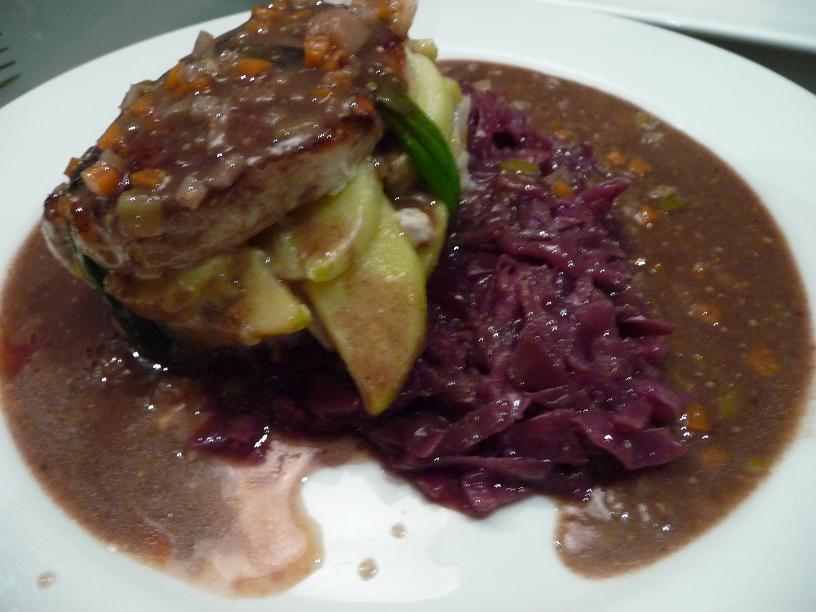
Red wine braised cabbage

I detest winter.

What I want is mangoes, pineapples, coconuts, a mojito and a banana lounge. With an ocean view. And the scent of frangipani on the breeze. Every year, without fail, at this time of year, I start yearning for sunshine. Fiji, Vanuatu, New Caledonia. Phuket. Bali. Hoi An. I am desperate for warmth.

What I’ve got is the coldest day on record, and root vegetables. And cabbage. And onions. Red cabbage, oh so slowly braised in red wine, cooked until meltingly soft and sweetened slightly with honey, is all that is keeping me from rapid escape to a tropical island.

A pot of stock, simmering all day on the stove, fills the house with steam. All day braising in the oven heats the room. It’s not tropical humidity, but it is warm and savoury and comforting.

Winter, seasonally and metaphorically, has a place and a point. Winter is about slowing down and resting and waiting, and being patient. Winter, with its biting wind and bitter cold, demands we stay put and relax. There is a more than one way to hibernate. It took a little bit of sulking, but I reminded that for me, hibination is rich with casserole and soup and steamed pudding and curry and roasted joints and stock. Putting things on the stove and forgetting about them and having a nap.

Vegetables don’t, strictly speaking, require the long cooking times and gentle low heats that really benefit sinuous cuts of meat. But the slow, slow cooking breaks down the cabbage, rendering it silky-smooth, and the grated potato releases sticky starches, contributing to a result that is soft and rich, without being cloying or heavy. Opening the oven while it is half way through cooking releases a cloud of wine flavoured steam, heady and inspiring.

So while the cabbage does it magic in the oven, I pour a glass of wine, curl up with a book and a hot water bottle, and wait. I may be dreaming of summer: but this too is part of winter. Daydreaming and waiting.


Braised cabbage

I came across this recipe in the French Laundry Cookbook and was surprised that it was simple, healthy and just perfect for winter. I’ve changed the quantities around to allow for more sensible, family portions (Thomas Keller is a bit keen on the ‘tasting menu tiny portions’, which is a great for a restaurant but less cool for eating at home).

1 tbsp olive oil
1 medium sized red onion, finely diced
½ red cabbage, very finely sliced (technical term: chiffonnade)
240 ml red wine
2 green apples, peeled, cored and grated
2 tsp honey
2 medium sized waxy potatoes, peeled and grated
Salt to taste

Pre heat oven to 170ºc.

Sauté the red onion over a low heat on the stove top in an oven proof casserole dish (or in a saucepan and then transfer to a casserole dish. Stir in cabbage, apples and red wine. The red wine will come about half way up the vegetables.

Press baking paper to cover the cabbage, cover with a lid (if you have one, or foil instead).

Cook in the oven for about 2 hours (longer is fine).

After two hours, remove from oven, stir through the honey and grated potato. Cover again with baking paper and lid. Cook in the oven for another hour.

Remove from oven, season with salt to taste. Add a little vinegar if preferred.

This a great side dish with chicken, pork, ham or fish. It’s probably a bit sweet for lamb and beef, but don’t let me stop you. Mustard or a mustard sauce complements this wonderfully.

Cabbage will keep in the fridge for up to a week.

Wednesday, June 23, 2010

On how quince paste melted my runcible spoon*

Quince. Botanical name: cydonia oblonga. Fruiting plant. It is the is the only member of the genus Cydonia. Turns the most fabulous brilliant deep red from its raw creamy-yellow when cooked over a long period. Naturally rich in pectin and tanin. Perfect for jam and jelly and stews.

No one really knows what a runcible spoon is**. Conjecture abounds: possibly it is like a spork, with bowl and prongs, or a splade, with serrated sharp edge and scoop. Or shallow and long handled. Or wooden.

Like the word runcible, quinces are unique. Unlike the word runcible (which is made up) quinces are an ancient fruit, grown since time immemorial, unchanged and unchanging. The Akkadians ate them, as did the Persians, classical Greeks and Romans. Apicius gives recipes for them (baked in honey or stewed with leeks), and Song of Solomon mentions them.

To my mind, this is a runcible spoon, capturing a sense of both runny and dribble, both of which describe the woeful melted plastic that occurs when you FORGET TO REMOVE THE DAMN SPOON WHILST BOILING QUINCE PASTE ON THE STOVE WHICH IS VERY STUPID.

Melted plastic does a grave disservice to any kind of conserve or jam-like substance. Thankfully, I did manage to remove all traces of the spoon from the quince paste, although the spoon itself is unsalvageable and has been consigned to the rubbish bin. Perhaps the wooden spoon would have been a wiser choice.

And still: I continued to persevere with the quince paste. Yes, I am even going to eat the damn stuff. It took me hours and hours to even get to melted-plastic point.*** Not to mention the 1.8kg of beautiful, misshapen, just-ripe quinces that I bought on a whim at the market just because they are in season, and divine-smelling and so terribly old-fashioned and retro and grandma-y and well, cool, in the same way that an original 1950s prom-dress is cool when you just happen to find it in a vintage shop and it fits and is made of silk and is fabulous.

Quinces even smell old-fashioned, a deliciously sweet musky perfume that reminds me of the powder-puffs that classy old ladies use.

Quinces are vintage, and vintage is in.

And quince paste is the quintessential quince recipe. Sweet and floral and tangy served with a cheese platter, or equal tasty as a jam, it is nanna-ish and more-ish. Have it with sherry.

* It is a universal law that whenever anyone ever eats, cooks, smells, looks at, thinks about or in any way is exposed to quince that they must think about the Owl and the Pussycat. This, of course, is because the Owl and the Pussycat ‘dined on mince and pieces of quince’.
** Edward Lear’s poem continues: 'Which they ate with a runcible spoon'. This was one of the many words he invented. Poets are allowed to do that.
*** I may have misunderstood the phrase “
weekend herb blogging” which I now believe means, ‘write about it over the weekend’ not, ‘spend all weekend engaged in cooking it and then melt a spoon in it’. I assume that Cook (almost) Anything at Least Once would encourage my attempt to cook the spoon itself, and Chris at Mele Cotte might focus on the quince and not the spoon as the requisite ‘herb or plant ingredient’.


Quince paste

Quinces. Water. Sugar. Roughly half as much sugar as quince, by weight. I used 1.5 kg quinces (raw) and 800 g sugar.

Rub the quinces to remove any of the dusty fine hairs on the skins. Quarter.

Cook the quinces in water, lid on, for about 45 minutes, until the quinces are softish. Strain, reserving about 1 cup water.

Mash the quince through a china cap. Discard the seeds and skin. (Some recipes suggest peeling and coring, and then adding this to the pan in a muslin sack – I have no muslin, so I discarded that stuff in the straining process, but if you do have a neat muslin sack, you can just discard it and then use a blender to pulp the quince, which is easier).

Weigh. Add an equal weight of sugar.

Return to a saucepan, with reserved liquid.

Simmer for about four hours until thick, goopy, and dark, dark red. Remember to scrape the bottom of the pan regularly, but also remember to remove the spoon from the pot. When thick enough that you can still see the bottom of the saucepan after you pull the spoon through, pour into a greaseproof paper lined tin and bake in an over at 50ºc overnight to dry out (6-7 hours should do it).

Cool, cut into pieces, wrap in greaseproof paper. Refrigerate. Eat with delicious cheese. Or spiced mince. Or spread on toast or scones. Serve with equally quaint and old-fashioned elderflower cordial.

Monday, June 21, 2010

Hazelnuts: also edible (especially with butter and Brussels sprouts)

The hazelnut is charmingly winter-blooming and pollinating, with fresh fruits harvested in the summer. Like most nuts they store perfectly in nature’s packaging (the shell, silly) and hence can be enjoyed in mid-winter, while the trees trail long blossoms on bear limbs.

And yet. The hazelnut, in literature and cultural tradition, occupies an ambiguous position.

Despite evidence that hazelnuts were cultivated and harvested on a large scale as early as 9000 years ago, the hazelnut features not as tasty treat, but symbolic riddle.

For Hamlet, only bad dreams stood between him and reign over infinite space, as defined by the bounds of a nutshell.* Elsewhere in Shakespeare, Queen Mab rides around in the some empty hazelnut shell, perpetually in motion distributing, one suspects, those same bad dreams.** Julian of Norwich had visions that the whole of the universe is a hazelnut in g-d’s palm***, Grimm’s fairytales suggest they keep us protected from snakes and vipers and all venomous things****, and Druidic legend suggests that a particular hazelnut-fed salmon imparts wisdom to the person who in turn eats the fish.*****

From Druidic folktales to Grimms’ fairtales, the mystic writings of mediaeval Saints to Shakespeare, the hazelnut repeatedly represents a profound metaphysical and moral contradiction.

Over and over, the edible is rendered inedible, and the physically real, metaphysically impossible. How could we think to eat the whole of creation? How can something real, tangible and mundane also be said to be infinite space? How can the whole of the universe be observed from a standpoint outside of the universe? Why fish-enhancing or reptile-repelling?

Why not just eat the damn things? Butter, salt, sprouts, hazelnuts.

No fairy queens, no troubled princes or wizards, no mystic saints or salmons or mothers of g-ds. Just brown butter sauce and toasted hazelnuts and braised Brussels sprouts.

* Shakespeare, Hamlet, Act II. Scene II:
[Hamlet]: O God, I could be bounded in a nutshell and count myself a
king of infinite space, were it not that I have bad dreams.
** Shakespeare, Romeo and Juliet, Act I. Scene IV:
[Mercutio]: Her chariot is an empty hazelnut,
*** Julian of Norwich The Showing of Love Chapter V
**** Jacob Ludwig Grimm and Wilhelm Carl Grimm The Hazel Branch
***** The bradán feasa

Braised Brussels sprouts with brown butter and toasted hazelnuts

Serves 4, as a side

100g hazelnuts
400g Brussels sprouts
60g butter
½ cup water
Sea salt

Toast the hazelnuts in large pan (or roast in a moderate oven) until golden. Remove from heat and rub with a tea-towel to remove the skins. Set aside.

In a large non-stick pan, stir 20gs butter into the water and bring to a simmer. Add sprouts and a pinch of sea salt. Cover and simmer gently for about 10-15 minutes, adding a little more water if the pan dries out before the sprouts are cooked through.

Remove the Brussels Sprouts and set aside. Add the remaining butter and hazelnuts and cook over a low heat until the butter is brown. Return the sprouts to pan and coat with butter sauce. Serve with roast chicken or grilled salmon.

Tuesday, June 15, 2010

Fool’s marigold – winter risotto, with mushrooms and leeks

“Winter tarragon ... is more often than not incorrectly sold to the unsuspecting as French tarragon”.* I, reckless and naive buyer of herbs, may have unwittingly stumbled upon a fake-tarragon fencing racket.

Over indulgence at the market had led to a basket full of winter root vegetables, brassicas and herbs. In amongst more purple radicchio, broccoli, English spinach, cauliflower, celeriac, sweet potato, quinces and Brussels sprouts than it is perhaps sane to purchase lay the even more indulgent acquisitions. Buddha’s hand lemons, French sheep’s milk cheese. And odd sweet smelling spikey herbs with yellow flowers, at which I had pointed without having a clue what they were.

“Tarragon” yells the girl, across piles of mushrooms and Jerusalem artichokes.

Not tarragon. Whence the long elegant dark green smooth tongues? And whither the delightful soft petalled bright egg-yolk coloured blooms? The scent was rich and liquorice-like, with spicy hints of cinnamon or nutmeg. Like, and yet unlike, tarragon. And what of its uncharacteristic mid-winter appearance?

As ever, when confronted with the alarming and the unknown, I came home and consulted the archives.*

French tarragon is a spring-through-autumn herb, which withers during the coldest of the winter months. It has a gentle and subtle liquorice flavour that is easily over-powered.

Tarragon, for the unwary, is a labyrinth of false trails. Beset on one side by ‘Russian tarragon’, a giant washed-out version, in colour and flavour, of French tarragon; and on the other by the mysterious plant “known as winter, Spanish or Mexican tarragon, which bears bright-yellow flowers, is sturdy and neat-looking with firm, dark-green leave and has a reasonably strong, spicy aroma similar to French tarragon”.*

Apparently, winter tarragon is a variety of marigold, and a perfectly safe and delicious substitute for tarragon. Finely shredded and mixed with avocado and fresh ricotta, it was lovely with poached eggs. And dehydrated in the oven and generously crumbed over mushroom and leek risotto, it enhanced the earthiness and creamy starches of the rice.

I may have been duped by the fines herbes equivalent of a fake Gucci bag, but I will always be a sucker for anything so pretty and unusual, and its flavour, rather than some preconceived notion, is what mattered in the end.

* Spice Notes by Ian Hempill

Mushroom and leek risotto with tarragon

The trick to risotto: constant stirring to release the starches around the rice, giving it that ‘creamy’ texture without adding actual cream. Make sure to coat the rice in the oils of the pan before adding liquid, add the liquid gradually as it is absorbed, and try to have the liquid at the same temperature as the risotto.

Serves 4

1 brown onion, finely diced
1 leek, washed and finely sliced (I use the green parts too)
50 g butter
1 tbsp olive oil
12 medium sized field mushrooms (about ½ kg)
1 cup risotto rice (I use Vialone Nano, a particular variety of risotto rice, but aborio or carnaroli are also perfect)
5 gm dried porchini mushrooms, soaked for 10 minute in ¼ cup warm water
2 cups English spinach
1 bunch winter tarragon, or French tarragon (if no tarragon is available, try 2 tsps finely chopped thyme or rosemary) – fresh or dehydrated.
Salt
1 litre water, warm to just simmering (you could use chicken or vegetable stock, but I find it’s not necessary)
50 gm finely grated parmesan

In a large heavy based saucepan over a medium, melt the butter and heat the oil. Add the onions and half the leek, stir until starting to soften. Add one third of the mushrooms, stir until softening.

Add the rice, and stir to coat. Add the porchini mushrooms and their liquid, and a ladle full of warm water, stirring constantly.

As the liquid is absorbed, add more warm water, stirring constantly.

Continue until the rice is almost cooked (this takes about half and hour). The rice should have a firm yet yielding texture, and the risotto should have a loose and sticky consistency. Add sea salt to taste.

In a separate saucepan, cook the remaining leeks and mushrooms in a tablespoon of olive oil, with half the tarragon. Set aside when the mushrooms are just cooked. (I do this so that some of the mushrooms and leeks retain a firmer texture when the meal is served).

When the rice is cooked, rapidly stir through the remaining mushrooms and leek, the English spinach and the grated cheese.

Spoon into deep dishes and scatter over the remaining tarragon.

Wednesday, June 2, 2010

Gnocchi: like it or lump it

The first time I made gnocchi was a disaster. Wanting desperately to impress a potato-mad paramour, I was left with a disintegrating collection of potato flavoured lumps. To be fair, this is what also happened the first time someone tried to make me gnocchi – a chef, and admittedly a very good one, that I happened to date, sought to impress me with the delicate Italian potato dumpling, and proceeded to produce a glue-textured and glue-flavoured bite-seized failure. (The idea behind that, however, was genius: cooked, and then pan-seared with pan-sweated baby spring-vegetables and French butter – it would have been delicious). Turned out as badly as the romance.

I have attempted gnocchi with and without eggs, flour, ricotta, all to varying degrees of failure.

Until recently I was taught, under pressure conditions, by a master*. And managed to produce something that was both flavourful and beautifully chewy with a light consistency. Turns out you have to fail a few times to get a real feel for the dough. So I tried again, with a recipe from a magazine** (which, as usual, I neglected to read correctly, and omitted the egg) – and succeeded in producing light, fluffy and sticky gnocchi that held their shape and absorbed the surrounding flavours.

And then again, mid week, capitalising on my success, I just whipped up gnocchi with caramelised bitter radicchio and peas and vanilla-and-rose-tea-smoked smoked duck. If I sound a wee bit cocky it’s because of the series of failures (romantic and otherwise) that preceded the triumph.

Moisture is the enemy: all the times I have succeeded, the potatoes have been individually wrapped in foil and oven roasted in their skins. I have pressed the potato through a sieve, without mashing (I do not have a ricer). I have kneaded lightly whilst still warm. I have not used eggs, I have not added liquid. I have been serious about avoiding overworking the potato so as to not stretch the starches too much. I have cooked in boiling water, at first one, tested and tasted, and then the remainder, whilst will slightly warm and soft. I have drizzled with olive oil and cooled, and then pan seared in olive oil and butter until slightly caramelised and hot again. I have snuck mouthfuls of just-cooked gnocchi, spinkled with sea salt, as a pre-dinner snack (quality control!).

Apparently, in Italian, the word gnocchi means ‘lumps’, which at once both accurately describes and deflates this incredibly fickle dumpling. I love their rustic lumpiness, their unevenness and general lack of elegance. And yet, when well-made, there is a velvetness, a simplicity that speaks to the richness of clay and the superiority of learned technique. So sublime a goal, I know I have many more years of romance and practice ahead to master the lump.

* Thank you, Matt Moran. You are a bald genius.
**
Australian Gourmet Traveller, Annual Cookbook 2010


Gnocchi

Serves 4

2 medium sized potatoes, approximately 300 g total
150 gm full fat ricotta cheese
50 g finely grated parmesan cheese
120 g plain flour
Sea salt, optional, to taste.

Pre heat oven to 180ºc. Wrap each potato separately in foil, bake in oven for approximately 45 minutes, or until cooked through. Remove from oven and set aside until just cool enough to handle.

Peel potato and press through a metal sieve. Press ricotta through the sieve, add flour and parmesan, (and salt if using) and mix together with hands until just combined.

Cut into four pieces. Working with one piece at a time, roll into a long sausage shape until approximately ½ inch diameter. Cut into 1 inch lengths, pinch slightly. Repeat with remaining peices.

To cook – add batches of gnocchi to rapidly boiling water. The gnocchi will sink to the bottom. As the pieces rise to the surface, remove with a slotted spoon and set aside on a lightly oiled tray.


You can eat then like this – just add sea salt, cracked pepper and little grated parmesan. Or ...

Sauté one finely sliced onion, two crushed cloves of garlic and one finely minced chilli in a little olive over a medium heat until caramelised. Turn heat to high, add 1 small head of torn raddichio and 1 cup of steamed peas and cook for about 5 minutes until soft. Add 50 g butter, melt until foaming. Add cooked gnocchi and cook, tossing pan occasionally, for 3 ish minutes, until caramelised and warm. Serve, with or without smoked duck.