Showing posts with label mushrooms. Show all posts

Tuesday, June 15, 2010

Fool’s marigold – winter risotto, with mushrooms and leeks

“Winter tarragon ... is more often than not incorrectly sold to the unsuspecting as French tarragon”.* I, reckless and naive buyer of herbs, may have unwittingly stumbled upon a fake-tarragon fencing racket.

Over indulgence at the market had led to a basket full of winter root vegetables, brassicas and herbs. In amongst more purple radicchio, broccoli, English spinach, cauliflower, celeriac, sweet potato, quinces and Brussels sprouts than it is perhaps sane to purchase lay the even more indulgent acquisitions. Buddha’s hand lemons, French sheep’s milk cheese. And odd sweet smelling spikey herbs with yellow flowers, at which I had pointed without having a clue what they were.

“Tarragon” yells the girl, across piles of mushrooms and Jerusalem artichokes.

Not tarragon. Whence the long elegant dark green smooth tongues? And whither the delightful soft petalled bright egg-yolk coloured blooms? The scent was rich and liquorice-like, with spicy hints of cinnamon or nutmeg. Like, and yet unlike, tarragon. And what of its uncharacteristic mid-winter appearance?

As ever, when confronted with the alarming and the unknown, I came home and consulted the archives.*

French tarragon is a spring-through-autumn herb, which withers during the coldest of the winter months. It has a gentle and subtle liquorice flavour that is easily over-powered.

Tarragon, for the unwary, is a labyrinth of false trails. Beset on one side by ‘Russian tarragon’, a giant washed-out version, in colour and flavour, of French tarragon; and on the other by the mysterious plant “known as winter, Spanish or Mexican tarragon, which bears bright-yellow flowers, is sturdy and neat-looking with firm, dark-green leave and has a reasonably strong, spicy aroma similar to French tarragon”.*

Apparently, winter tarragon is a variety of marigold, and a perfectly safe and delicious substitute for tarragon. Finely shredded and mixed with avocado and fresh ricotta, it was lovely with poached eggs. And dehydrated in the oven and generously crumbed over mushroom and leek risotto, it enhanced the earthiness and creamy starches of the rice.

I may have been duped by the fines herbes equivalent of a fake Gucci bag, but I will always be a sucker for anything so pretty and unusual, and its flavour, rather than some preconceived notion, is what mattered in the end.

* Spice Notes by Ian Hempill

Mushroom and leek risotto with tarragon

The trick to risotto: constant stirring to release the starches around the rice, giving it that ‘creamy’ texture without adding actual cream. Make sure to coat the rice in the oils of the pan before adding liquid, add the liquid gradually as it is absorbed, and try to have the liquid at the same temperature as the risotto.

Serves 4

1 brown onion, finely diced
1 leek, washed and finely sliced (I use the green parts too)
50 g butter
1 tbsp olive oil
12 medium sized field mushrooms (about ½ kg)
1 cup risotto rice (I use Vialone Nano, a particular variety of risotto rice, but aborio or carnaroli are also perfect)
5 gm dried porchini mushrooms, soaked for 10 minute in ¼ cup warm water
2 cups English spinach
1 bunch winter tarragon, or French tarragon (if no tarragon is available, try 2 tsps finely chopped thyme or rosemary) – fresh or dehydrated.
Salt
1 litre water, warm to just simmering (you could use chicken or vegetable stock, but I find it’s not necessary)
50 gm finely grated parmesan

In a large heavy based saucepan over a medium, melt the butter and heat the oil. Add the onions and half the leek, stir until starting to soften. Add one third of the mushrooms, stir until softening.

Add the rice, and stir to coat. Add the porchini mushrooms and their liquid, and a ladle full of warm water, stirring constantly.

As the liquid is absorbed, add more warm water, stirring constantly.

Continue until the rice is almost cooked (this takes about half and hour). The rice should have a firm yet yielding texture, and the risotto should have a loose and sticky consistency. Add sea salt to taste.

In a separate saucepan, cook the remaining leeks and mushrooms in a tablespoon of olive oil, with half the tarragon. Set aside when the mushrooms are just cooked. (I do this so that some of the mushrooms and leeks retain a firmer texture when the meal is served).

When the rice is cooked, rapidly stir through the remaining mushrooms and leek, the English spinach and the grated cheese.

Spoon into deep dishes and scatter over the remaining tarragon.

Wednesday, April 21, 2010

Glazed and confused

I wanted to make salad. Chicken and spinach salad. Thrown together with whatever was available and not completely disastrous looking at the 24 hour supermarket on the way home. Sweet potato, orange and earthy. Giant mushrooms. With walnuts. And roast capsicum. And fetta cheese dressing. Maybe olives? Just something really quick, really simple. Week night: long day.

I am easily distracted at times.

Glass of wine. Maybe caramelise the walnuts? With orange rind? That would use up the orange that’s been sitting in the fruit bowl since I decided a few days ago that I needed more vitamin C (you have to eat them, not just buy them ...)

Then – balsamic vinegar. Something a bit sour to balance the caramel? With mushrooms? Roasted in the balsamic vinegar. I overcooked the sweet potato. So I pureed it. With olive oil.

Just pan fry the chicken. Easy. Then – why not add fennel seeds? Then – why not add the juice of the orange? Instant glaze.

Much like my expression.

This does not look like salad.


Orange and fennel glazed chicken with balsamic roast mushrooms and sweet potato puree.

Serves 2

For the puree sweet potato, cook the 300 gms sweet potato (I peeled, dice and blanch) until soft.

Mash with enough olive oil to make a smooth yet thick puree, and set aside.

Balsamic roast mushrooms

These mushrooms are great with salad, accompanying meat or as a killer vegetarian main served with white bean puree.

Olive oil
2 large flat field mushrooms
Balsamic vinegar

Pre heat oven to moderate (180ºc). Oil a baking dish. Place mushrooms stalk up in baking dish, drizzle ½ balsamic vinegar into each mushroom. Roast for about ½ hour until soft but not falling apart.

Orange and fennel glazed chicken

2 tsp olive oil
2 chicken breasts, skin off
1 ½ tsp fennel seeds
Juice of 1 orange

Heat olive oil in a non stick pan. Add chicken breasts and cook on one side for about 4 to 5 minutes. Turn breast over. Add fennel seeds. Cook for 3 to 4 minutes. Add orange juice. Move the chicken around in the juice to coat, then turn over and coat on the other side. The juice will turn sticky and make the chicken shiny. Turn off the heat and cover (this will keep the chicken warm until serving).


Caramelised walnuts

¾ cup walnuts
2 tsp icing sugar
Rind of 1 orange, finely grated
Pinch of salt + pepper
½ cup oil (I use olive oil, but vegetable or canola would also work)

Blanch walnuts in boiling water for 3-4 minutes (this softens them a little – makes them soft in the middle and crispy on the outside after you finish caramelising them).

Drain and shake off excess water. Toss through with icing sugar, rind and salt and pepper.

Heat about 1.5cm oil in a small pan until bubbly. Add coated walnuts and fry for about 1-2 minutes until browning and crispy. Drain off oil and cool. (this can be done in advance – the walnuts store in an air tight container for about a week. They make a pretty good snack too).

To serve – place a dollop of sweet potato puree on a plate, top with chicken and mushroom, scatter with caramelised walnuts. Serve alongside a green salad.

Saturday, March 27, 2010

Being humbled by pie

Pie is easy.* You can buy it frozen and pop it in the oven. That pie is humble: it doesn’t ask for much, doesn’t expect much, doesn’t particularly offer much either, just sits quietly in the freezer, then the oven, then disappears quickly without much comment.**

Eating fancy meals can be demanding: there is an extra attentiveness we tend to approach a glamorous dish with, as opposed to the unwinding we allow ourselves when we sit down for a traditional home cooked meal. Something intimidating, something attention-grabbing about a restaurant meal. It is special food for a reason. We hesitate, we pause, we pay that momentary respect, that intake of breath, that thoughtfulness.

The direction of the breath we take is pivotal, I think, in defining the difference. Restaurant food: intake. Wonder. Home cooking: exhale. Relaxation.

A few weeks ago I attempted a recipe from Thomas Keller’s cookbook The French Laundry. It was pretty complicated, involving making duck stock and then a reduced duck sauce. Creamed corn, which involved pureeing fresh corn kernels, then straining them, then cooking them, then adding whole blanched corn kernels. Oh, and blanched silverbeet wrapped skinned duck breast, cooked sous vide (ie, wrapped in plastic then poached).
The meal took a whole day, and was an exercise in peeling, precision dicing, watching, skimming, straining ... The end result was delicious, but damn, it would want to be for the effort it took to produce one dish.

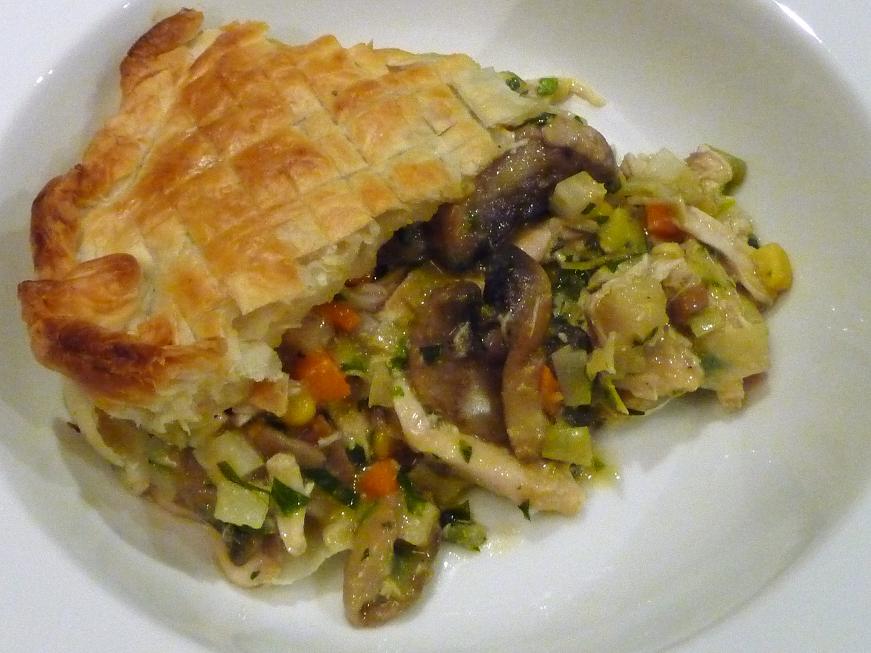
Taking this recipe as a starting point, I thought about pie. What if you took the basic components - duck, mushroom, corn - and made pie? Mixed everything up together? Mushrooms fried with roughly chopped leeks and thyme. Poached the chicken (that way, if it doesn’t work, I’ve only lost my investment in chicken, and not a duck). The diced brunoise is transformed into diced vegetables. The creamed corn and reduced poaching liquid from the chicken becomes the binding gravy. From fancy restaurant food to rustic, home-style comfort food.
Easier to eat.

Not easier to make.

It took me nearly as long to make the pie as it did to make the Keller recipe. Poaching the chicken the night before. Reducing the stock. Chopping the vegetables. Cooking the sauce. Frying the mushrooms. Pulling the chicken off the carcass. Baking the pie. (Thank goodness for store-bought pastry!).

But there was a gentleness about the process – a shift in the expectation. This pie didn’t need to be perfect. It didn’t need to wow anyone. It didn’t have to look like a jewel, be perfectly sized or shaped. It didn’t really rely on split second timing. When we sat down to eat, we breathed out.

* ‘Easy as pie’ doesn’t describe the ease of creation, but rather the pleasure of eating, the idea being that good things are also easy to like – easy on the eye, for example. ‘Easy as pie’ comes to us from American English (check out Mark Twain and all the pie references).

** Humble pie is little bit older – from the old English ‘numble’ or ‘umble’ pie – pie made from deer offal. Perhaps also eaten by the lowly of station. By a phonetic slight of hand: ‘umble pie (think of Michael Cain saying it). Humble pie. Numble pie eaten by the humble.

Chicken, corn and mushroom pie, a play in four acts

Act 1: The poaching of the chicken (the day before)

2 1 kg chickens (whole or with thighs removed – depend what fits into the pot)
1 carrot, cut in half
1 brown onion, peeled and cut in half
6 sprigs of parley
10 sprigs of fresh thyme
2 bay leaves

Place all ingredients in a large saucepan. Cover with cold water. Bring to boil, simmer for about 20 minutes. Cover with a lid and turn off the heat. Allow to cool, then refrigerate overnight (I put the whole saucepan in the fridge.

The next day, scrape the fat from the top of the stock. Remove the chicken, discard the skin and pull the meat off the bones. Shred the meat and set aside.

Strain the poaching liquid and reserve.

Act 2: A kernel of corn

Poaching liquid from the chicken
Kernels from 3 cobs corn
2 carrots – cut in ½ cm dice
200 g celeriac – cut in ½ cm dice
1 leek, white part cut into 1 cm dice
¼ cup polenta

Bring the chicken poaching liquid the boil in a medium sized saucepan and reduce to about 4 cups.

Puree the 2/3 of the corn kernels with a cup of poaching liquid. Strain and discard the solids. Return the puree to the stock, add the polenta and slowly cook until it starts to foam. Add the remaining corn kernels and diced vegetables and continue to cook until the sauce thickens and the vegetables are just cooked.

Set aside.

Act 3: Mushrooms

½ kg mushrooms (I used field mushrooms, but any combination will be fine), thickly sliced
2 leeks, chopped into 1 cm dice
2 tbsp chopped thyme
1 tbsp chopped oregano
1 bay leaf
2 tbsp olive oil

Throw everything into a non stick fry pan and cook until the mushroom are soft, shaking the pan occasionally to prevent sticking. The mushrooms will release liquid, which will evaporate.

Act 4: the assembly of the pie

Shredded chicken
Thickened corn gravy with vegetables
Fried mushrooms
Pastry (enough to line and lid your pie dish)


Heat the oven to 180ºc

Mix the shredded chicken, mushrooms and corn mixture together. Taste and season (note – nothing has had any salt or pepper added yet).

Line the pie dish with pastry, fill with the pie filling, cover with a pastry lid. Brush with egg wash or milk.

Place into the oven, and cook for about half an hour (if the top starts to brown, cover with foil whilst the pastry base continues to cook).


Monday, March 8, 2010

Chicken cacciatore: food for when it rains


I live here because it doesn’t snow. I love summer, humid weather, cotton dresses and Pimms cup. And as my city was hit by devastating and spectacular hail storms over the past two days I started to dread the long steep decent into autumn and winter, and the all too short thawing of spring. It may not snow here, but for nine months it is pretty damn cold.

Weather is evocative of food: summer is stone fruit and mangoes and seafood and salad and pineapple sorbet. Autumn is always mushrooms. The last of the tomatoes and the start of slow cooking. Dried beans and chard, potatoes and apples and pears. This is the stuff that keeps me going as the weather turns nasty.

We had invited people around for dinner on Sunday night, but with flooded roads and predictions of more wild storms, we started calling around asking our friends not to travel. Ordinarily this might seem an over-reaction, but I had seen for myself how the storms ripped through from the north into Melbourne on Saturday. My train back from a short visit to the country had been stopped an hour out of town, and the replacement coach took nearly four hours to get back. The bus depot was flooded, ankle deep in water. Roads were closed. Piles of ice lay at the sides of the road. Under the circumstances, not everyone came round. I certainly wouldn’t have wanted to have been far from home last night.

All I wanted as the rain and wind whipped our windows was old fashioned Italian comfort food, the kind that simmers all day on the stove, making the house smell like onions, then tomatoes, then wine, then herbs, then just warm and savoury as it bubbles away.

In fact between the chilli chocolate soufflé cake* I cooked in the morning (filling the house with the scent of melted chocolate) to the fava bean dip (slowly cooked on the stove in onions and celery and thyme)* and the aroma of chicken cacciatore, I could just about bear the onset of winter.

I realise that cacciatore is a dish that has significantly changed over the centuries, but at its base it is the dish cooked by hunters, out in the forest, bulked out by the ingredients to hand: wild mushrooms, wine, cured meat, rabbit or chicken, wild herbs.


It’s a dish perfect for the start of autumn: rich with pureed fresh tomatoes, just starting to be squishy and overripe (picked up at a country market stall), cultivated mushrooms made more rich with the addition of dried porcini, a generous dash of red wine and smoky rich bacon from the organic pig farm I visited on Saturday morning. Served with slow cooked polenta, rich with sheep’s milk percorino. Cosy, warm and safe.

And plenty of left-overs.

* see http://www.exclusivelyfood.com.au/2006/07/flourless-chocolate-cake-recipe.html for the recipe. I added 1 teaspoon of ground chilli, ½ teaspoon cinnamon and ¼ ground ginger, and left out the vanilla. Tip: make sure you use very finely ground almond meal.


Chicken cacciatore

Generously serves six

12 chicken drumsticks, skin and knuckle removed
¼ cup corn flour
Salt and pepper
2 brown onions, diced
150 gm really good bacon
300 gm carrots, diced
300 celery, diced
4 cloves garlic, minced
4 sprigs thyme
1 sprig rosemary
200 ml red wine
1 kg fresh tomatoes, peeled and pureed
1 kg mushrooms
5 gms dried porcini, soaked in ¼ cup water for about 20 minutes.

Coat the drumsticks in seasoned cornflour. Heat olive oil in very large saucepan, and cook the drumsticks until browned all over. Remove and set aside.

Add more olive oil to the pan, add the chopped onion and bacon and cook for a couple of minutes, until softening. Add the celery, carrot and garlic and cook until soft and starting to caramelise. Add the red wine and boil off the alcohol (the smell of alcohol will disappear). Add the pureed tomatoes and herbs, heat through. Return the chicken to the sauce, reduce heat to a slow simmer, and cook for an hour or so.

Half an hour before serving, add mushrooms and porcini (discard water).

Serve over slow cooked polenta or pasta or rice.

Saturday, February 13, 2010

An abundance of tomatoes: pasta sauce

My mum has the most beautiful little vegetable garden. She just lives in a small suburban house, her backyard would be smaller than a tennis court. In amongst the camellias and gardenias she grows, depending on the seasons, cucumbers and tomatoes and kale and potatoes, garlic, leeks, cabbage, lettuce, chillies, basil, chard, celery, roquette, or carrots. She’s talking about planting kohlrabi and maybe even cardoons. She has a lemon tree and a lime tree, a bay laurel and olive trees in pots.

When mum moved into her house, just over a year ago, the yard was a lunar landscape. Uneven mounds of dirt, patches of grass. That was about it. The transformation in the last year has been magical.

One of her first crops out of the garden was little button squash. Picked when about the size of large strawberries, and served steamed with torn basil leaves, also from her garden, and a sprinkle of sea salt and olive oil, these were sweet and nothing at all like the bitter, soggy taste I used to associated with button squash. I couldn’t eat enough of her squash that first season.


She grows things just for the love of growing them, and as a result always has far too much all at once. This means that at least once a week I am given boxes of vegetables picked within the last hour. When her tomatoes started to grow fruit, and the spindly branches were heavy and unripe, she picked a selection of green tomatoes for me to play with (who could risk trying to make fried green tomatoes?). Now the tomatoes are ripening, and I have box after box of yellow grape tomatoes and green tiger stripes and black Russians and giant ox-heart looking ones she insists were called ‘mortgage busters’ on the seed packet.

I live in a shoe box city apartment. I don’t yet even have herbs in boxes on my coffee table sized balcony. A whole box of bright yellow and red and green smelling of summer, grown with love by someone who loves me? Pretty damn special, every time.

The latest harvest to arrive at my door was a box full of these tomatoes, chillies, tiny capsicum and basil. When we came home late, dinner was a matter of throwing the remanents of two different pastas into some boiling water, and then cooking down the tomatoes and capsicum and chillies with some chopped bacon (the only other thing in the fridge) and garlic. No water, no wine, no onions, just a little salt and pepper to help it along.

The bacon is cured a block away, by my wonderful old-school butcher. Everything else was fresh that day from the garden. It was not pretty or well-plated or delicate. It was sweet and spicy and fresh and thoroughly satisfying.


Pasta all'amatriciana

For 2

A dash of olive oil
6 short rashers of bacon, roughly chopped (or pancetta, about 10-12 thin slices)
3 clove minced garlic
½ kg super ripe tomatoes, any variety, roughly chopped
3 chillies, minced
1 small red capsicum, finely chopped
Handful chopped fresh basil
400 g dried pasta, any variety

Fry off the bacon in the olive for a few minutes, add garlic, stir and then add the tomato, capsicum and chillies. Cook for as long as it takes the pasta to cook to al dente.

Drain the pasta, and add to the sauce along with the chopped basil. Season to taste.

Serve with shaved parmesan. Scoff.