
Showing posts with label "experimentation". Show all posts

Saturday, February 12, 2011

Vanilla and rose tea smoked duck

If Delhi was lacking in clean water and fresh vegetables, it was also lacking in another equally taken-for-granted commodity: clean, fresh air. It is possible my lungs will never forgive me for breathing in the dirty smog, a mixture of burning coal and exhaust fumes and kerosene and wood fires servicing the needs of a city of 14 million people in 1500 square kilometres*.

Breathing in air that felt dirty, oily, tainted: it did not make for much of an appetite.

There is no doubt that there is a link between taste and smell**. We eat with all our senses. Ferran Adria, the mad genius behind El Bulli, is reported to on occasion serve dishes that are accompanied by recordings, (for example, of the sound of the sea) and to spray diners with specially concocted fragrances (like pine wood or autumn earth or sea spray) to enhance their dining experience. But nothing tastes as sweet as clean air.

It’s no wonder that every crowded Delhi corner hosts a chai wallah, dispensing milk-rich and sweetened spiced tea, a steamy aromatic remedy against the encroaching smog.

And no wonder too, that my usually endless craving for smoked and smoky food was also on holiday while I was in Delhi. The smoky, peaty notes in a good single malt whiskey are to be treasured only when the air is crisp and clear and cold. So too the flavour of wok tossed tofu, the incredible heat in combination with sweet soy sauce sending delicate curls of burning sugars around everything. The taste of barbequed spare -ribs, sticky with sweet-hot-sour sauce and infused with smouldering hickory wood chips. Smoked salmon and kippers and bacon and ham and muscles and chipotle chillies and paprika. Bonfires and toasting marshmallows and billy tea and damper and open fireplaces in winter and hot chocolates.

While cold smoking a ham is a) my dream, and b) beyond me in my current location (including our overly sensitive smoke alarm which is deeply committed to the saying that where there’s smoke there’s a fire); hot smoking small portions of this and that is as easy as steaming. In fact, the method is nearly exactly the same.

* At the end of the nineteenth century London was famous for her yellow smog, that gentle pollution which turned the great city golden and allowed her visitors to view her as if through a Vaseline smeared lens. Delhi, taking her turn at industrialisation on a truly epic scale, imitates – and I believe exceeds – the capital of her former colonial occupiers. India has its own path to follow, but I do hope it involves some version of the Clean Air Act.

** This is probably why, whenever I have a head cold, and therefore cannot smell, I attempt to exist on nothing but olives and chillies. Chilli marinated olives for preference, because the salt and heat at least registers on my tastebuds.
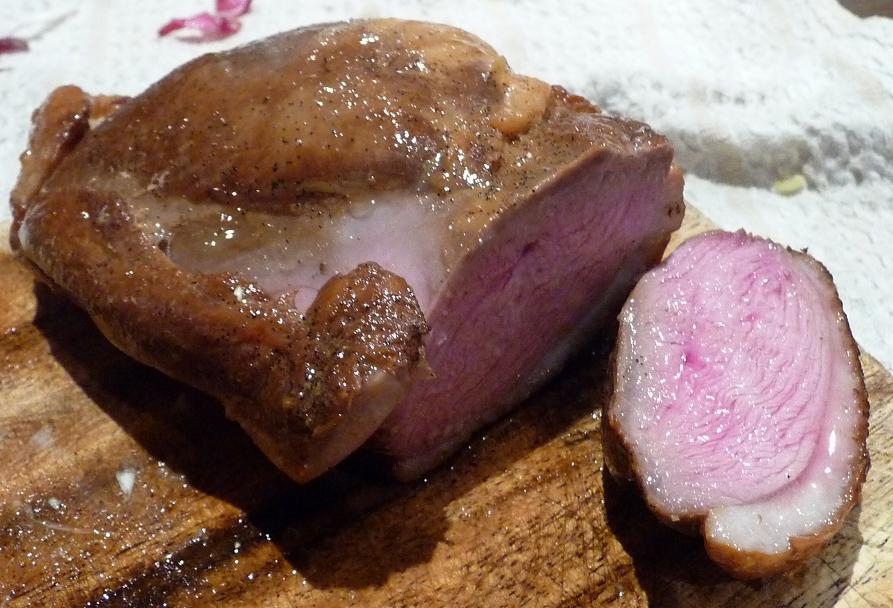


Vanilla and rose tea smoked duck

Serves two

1 large wok, with lid
Lots of tin foil
2 duck breasts, skin on
1 cup long grain rice
1 cup rose tea (black tea with rose petals)
1 vanilla pod, cut into 3 pieces
1 cup course sugar
Vanilla salt, optional

Gently score the skin of the duck breast fillets, taking care not to slice all the way through the fat. Rub a little of the vanilla salt if using. Place the duck fillets skin side up on a piece of foil.

Line the wok with four to five layers of tin foil. This is very important, otherwise you will destroy your wok.

Place the tea, rice, sugar and vanilla pod into the wok and stir to combine. Lightly place another piece of foil over the mixture. Cover the wok with the lid and place over a high heat. After about 5 minutes, the wok will be filled with smoke.


Remove lid and place the foil with the duck into the wok, directly on top of the rice and tea mixture. Replace the lid and smoke for about ten minutes (no more).

Heat a grill pan to very hot.

Remove duck from wok, and place skin side down in the grill pan. Cook for 4-6 minutes, until the skin is very crispy.

Remove from pan and rest for 5-10 minutes before serving and rest.

Toss through a salad of citrus and rose petals and shaved fennel, or serve with char-grilled broccoli and mashed parsnips.

Saturday, May 22, 2010

Rosé veal with rosé sauce and tiny toasted flower buds

I love the soft, sweet flavour of veal. I love the gentle pinkness of rosé veal, the only kind of veal I can bring myself to eat.* From there it is all word association and day dreaming with me.

Given how perfect white wine sauce is with veal, it is only a short step to matching a dryish rosé. I’m not a wine snob (as evidenced by my choice of wine to cook with solely on the basis of whim and colour). Rosé veal with rosé wine sauce just sounds clever.

In my culinary fantasy-world I imagine a dish scattered with rose petals or perhaps preserved or jellied rosehips, sweet and sour and floral. I’m imagining Heston Blumenthal type presentation, with little petals cut out of veal scaloppine arranged like a flower on the plate. It’s twee and arty and probably has fennel pollen scattered on it.

Setting aside my rose coloured glasses I instead make something much simpler. In the real world dinner takes fifteen minutes to cook. It is light, easy and tasty. Tenderised veal scaloppine, lean and quick cooking. Browned on both sides in a very lightly oiled non stick pan and then removed. I deglaze the pan with a glass of rosé. Boiled, reduced. Add the veal back in. I could strain it, but seriously, I am firmly back in the real world. Simmer, whilst steaming some vegetables. Five minutes later, it’s ready. Tip onto a plate – rosé veal with rosé sauce. Clever, quick, delicious.

Except: I can’t resist. In the wiped out pan, I heat some olive oil to sizzling. And I scatter in some little caper buds, preserved in white wine vinegar. They start to pop and crackle, brown and turn a little crispy. Little tiny toasted flower buds, scattered over the top. Not roses, but a savoury-sour floral flavour addition, pretty and nearly as clever.

* I know that, like my reticence regarding rabbit, many people struggle with the idea of eating veal.
There is veal and there is veal. Rosé (or pink) veal is the kind that involves a more ethical and humane treatment – or at least avoids the worst treatments that have been traditionally associated with veal rearing. Please, please talk to your butcher about the origins of all your meat.
Rosé veal with rosé sauce and toasted capers

[Edited 24 May 2010] When Helen emailed me, from the other side of the world, I was a little surprised. I had sent her a recipe in response to her “Blogger Secret Ingredient Challenge” (capers) because there, in London, England, was a cook and writer and thinker who though things I would like to think and cooked things I would like to eat. To win, an even bigger surprise.
Serves 2

1 tsp olive oil
2 large veal scaloppine, tenderised
100 ml rosé (or dry white wine)
1 tbsp olive oil
1 tbsp capers in white wine vinegar (you could used salted, but rinse well first), drained and pat dry

Steamed or sautéd vegetables, to serve

Heat a non stick pan (big enough to fit the veal all at once – if your pan is only big enough to hold one piece, cook one at a time) to very hot. Add a teaspoon of olive oil. Sear the scaloppine on each side until quite brown and cooked through. Remove from pan and set aside.

Add wine to the pan – it will foam and boil almost instantly. Boil for a couple of minutes, until reduced and thickened slightly. Add the veal back to the pan and cook for a further five minutes. place a piece of veal on each plate and drizzle with remaining sauce.

Wipe out the pan (or use a clean one, it depends on how much washing up you want to do) and heat the olive oil. When hot, add the capers. Cook for about a minute, shaking the pan to prevent from burning or sticking. Scatter over the top of the veal.

Serve with a glass of rosé.


If you want dessert, try this.

Tuesday, May 18, 2010

Prosciutto wrapped roasted lapin: bunnies, bunnies, it must be bunnies*


This week has been marked by a restlessness: a desire to push my comfort zone and tackle the odd and the unknown.

The foray into rabbit, whilst not exactly a disaster, revealed for me the personal operation of a cultural taboo around food consumption. In short: I found this confronting. And I was surprised to be confronted. After all, I have autopsied calamari and daintily eaten a tichy-tiny whole quail and cooked live mussels and plucked a chicken and eaten raw horse. I have been offended when guests refuse to eat veal. I am not squeamish nor fussy.

Except: the consumption of the hoppity back legs of a little bunny: a bridge too far. It should have been delicious: wrapped in prosciutto, pan-seared in foaming butter and roasted in thyme and sage, served with pumpkin and parsnip puree and a reduced jus of wine and rabbit stock.

But there were tendons and unfamiliar bones and above all the little voice in the back of my head which kept saying ‘BUNNY’ over and over. The strength of my reaction was utterly unexpected.

I was reminded, both of Anya in Buffy the Vampire Slayer and her dreadful fear of rabbits*, and the introduction to the Orders of Things*, because I found myself face to face with the laughter that shatters and the stark impossibility of eating that.

The question underneath this for me is: what other assumptions and cultural preferences am I blind to? Is irrational food avoidance (ie, not consciously chosen and without foundation) any different to other kinds of prejudice? And am I already too comfortable (and well fed) to even notice?

* For example: Episode 7, Series 6, Once more with Feeling: “Bunnies aren’t just cute like everybody supposes, they’ve got those hoppy legs and those twitchy little noses. And what’s with all the carrots, what do they need such good eyesight for anyway?”. (Directed by Josh Whedon).

** “This book first arose out of a passage in [Jorge Luis] Borges, out of the laughter that shattered, as I read the passage, all the familiar landmarks of my thought—our thought that bears the stamp of our age and our geography—breaking up all the ordered surfaces and all the planes with which we are accustomed to tame the wild profusion of existing things, and continuing long afterwards to disturb and threaten with collapse our age-old distinction between the Same and the Other. This passage quotes a ‘certain Chinese encyclopaedia’ in which it is written that ‘animals are divided into: (a) belonging to the Emperor, (b) embalmed, (c) tame, (d) suckling pigs, (e) sirens, (f) fabulous, (g) stray dogs, (h) included in the present classification, (i) frenzied, (j) innumerable, (k) drawn with a very fine camelhair brush, (l) et cetera, (m) having just broken the water pitcher, (n) that from a long way off look like flies’. In the wonderment of this taxonomy, the thing we apprehend in one great leap, the thing that, by means of the fable, is demonstrated as the exotic charm of another system of thought, is the limitation of our own, the stark impossibility of thinking that.” Michel Foucault The Order of Things: An Archaeology of the Human Sciences Pantheon Books 1970

Wednesday, April 28, 2010

Beetroot Caramel: a work in progress


Beetroot caramel – possibly as crazy as it sounds

It doesn’t take much to amuse me. For example,
this add* reduces me to fits of laughter. Every. Time. And the surprised kitty? I can watch that on a continuous loop and weep.

I like to laugh, and I like to make people laugh. I have a very good friend who is a boxer and personal trainer. He is probably one of the funniest people I know. It’s a bit of a challenge for me, to try to find something that will make him laugh. Because he’s not just funny, he’s really good at keeping a poker face. No matter how funny something is, he’ll rarely crack a smile. I think this is because he knows that people will laugh even harder, and joke around even more just to try to get him to give in.

One of the things I like to do is say outrageous things to him, just to try to shock him into giggling. Just a bit. Mostly though, he just laughs at me when I’m not trying to be funny. This is devastating, because he still wins. He’s still the funniest, because this isn’t about me being funny, but about him finding the funny in a situation.

A little while ago we were talking about beetroot. And the joke, finally, may be on him.

It started out serious: the merits of tinned versus fresh. I, as ever, the advocate for fresh. Sure, steam, boil and/or pickle if you feel the need, but start with the fresh b’root. I argued for raw-grated, whole-baked-in-foil, unpeel-steamed, juiced and borscht (yes, I even bought up the borscht). He, as ever, remained underwhelmed by my passionate defence. Refused to rise to the emotion of the debate. Refused to even concede there could be a difference (he wouldn’t even defend the primacy of the tin. Just that it made no difference!).

And then it popped out – beetroot caramel. Dessert beetroot. The ultimate in the absurd. Finally, he cracked, a little, a tiny, miniscule crack. And then, the poker face reasserted. He questioned the sanity of such a suggestion. Claimed it just wouldn’t work.

Challenge accepted. Less a case, now, of ‘can I make him laugh?’, and more a case of calling his bluff. What was a whimsical throwaway line was now a serious challenge.

I’ve played around in my head with different ideas for how this beetroot caramel could work. And it does make sense – beetroot is already sweet, and already a delicious dessert purple colour. We make pumpkin pie, and yam pastries. I have been known to consume sweet potato with condensed milk (don’t ask). It’s not so ridiculous after all.

Ideas have included: mandolin sliced beetroot, sprinkled with confectioner’s sugar and baked in the oven until crisp (with coffee); grated beetroot, air- (or oven-) dried, mixed with toasted pine-nuts and then drizzled with burnt sugar caramel (a little like a praline in my head – serve with yoghurt or ice-cream); whole roasted beetroot, cubed and then dipped in caramel like a toffee apple and sprinkled with sea salt (with dessert wine or port); beetroot crème-caramel, with pureed steamed beetroot blended with cream and eggs topped with a orange-chilli caramel sauce.

At some point I clearly forgot that I have no particular talent for making anything sweet.

My first attempt at beetroot praline looked fantastic (or at least better than I expected)– however, I burnt the caramel, which made everything far too bitter, and the sweetness and colour of the beetroot was lost in the dehydration. But I was not ready to give up on this idea yet.

Beetroot-toffee-apples: also a miserable failure. The beetroot went soggy. And the caramel wouldn’t stick.


Spicy beetroot custard pie with toffee crisps was the closest I’ve come yet. Chocolate and orange rind shortcrust pastry, custard spiced with copious amounts of cinnamon and cardamom, enriched with strained mashed roasted beetroot. Topped with sugar lace, just melted in the oven then hardened. The trouble was – not beetroot-y enough. Also, my pastry technique is pretty much non-existent.

I maintain however, that it’s not insane at all.** The key? Balancing the sweetness of the beetroot with that almost bitterness that a good caramel can impart, and balancing the texture of the beetroot – soft with hard, mushy with crispy. I just haven’t managed it yet.

* I don’t even watch the show. I don’t even eat this product. It’s just insanely funny to me.

** And imagine my surprise when I saw, on the menu of a fantastic restaurant recently ‘mango bavarois with caramel beetroot’. Of course I ordered it. Only to be informed that the chef had taken the beetroot off the dish – turns out, the caramel melts in their tropical heat. I ordered the dish anyway – the caramelised slice of lime and coconut and chilli sambal more than made up for the disappointment!

Saturday, March 27, 2010

Being humbled by pie

Pie is easy.* You can buy it frozen and pop it in the oven. That pie is humble: it doesn’t ask for much, doesn’t expect much, doesn’t particularly offer much either, just sits quietly in the freezer, then the oven, then disappears quickly without much comment.**

Eating fancy meals can be demanding: there is an extra attentiveness we tend to approach a glamorous dish with, as opposed to the unwinding we allow ourselves when we sit down for a traditional home cooked meal. Something intimidating, something attention-grabbing about a restaurant meal. It is special food for a reason. We hesitate, we pause, we pay that momentary respect, that intake of breath, that thoughtfulness.

The direction of the breath we take is pivotal, I think, in defining the difference. Restaurant food: intake. Wonder. Home cooking: exhale. Relaxation.

A few weeks ago I attempted a recipe from Thomas Keller’s cookbook The French Laundry. It was pretty complicated, involving making duck stock and then a reduced duck sauce. Creamed corn, which involved pureeing fresh corn kernels, then straining them, then cooking them, then adding whole blanched corn kernels. Oh, and blanched silverbeet wrapped skinned duck breast, cooked sous vide (ie, wrapped in plastic then poached).
The meal took a whole day, and was an exercise in peeling, precision dicing, watching, skimming, straining ... The end result was delicious, but damn, it would want to be for the effort it took to produce one dish.

Taking this recipe as a starting point, I thought about pie. What if you took the basic components - duck, mushroom, corn - and made pie? Mixed everything up together? Mushrooms fried with roughly chopped leeks and thyme. Poached the chicken (that way, if it doesn’t work, I’ve only lost my investment in chicken, and not a duck). The diced brunoise is transformed into diced vegetables. The creamed corn and reduced poaching liquid from the chicken becomes the binding gravy. From fancy restaurant food to rustic, home-style comfort food.
Easier to eat.

Not easier to make.

It took me nearly as long to make the pie as it did to make the Keller recipe. Poaching the chicken the night before. Reducing the stock. Chopping the vegetables. Cooking the sauce. Frying the mushrooms. Pulling the chicken off the carcass. Baking the pie. (Thank goodness for store-bought pastry!).

But there was a gentleness about the process – a shift in the expectation. This pie didn’t need to be perfect. It didn’t need to wow anyone. It didn’t have to look like a jewel, be perfectly sized or shaped. It didn’t really rely on split second timing. When we sat down to eat, we breathed out.

* ‘Easy as pie’ doesn’t describe the ease of creation, but rather the pleasure of eating, the idea being that good things are also easy to like – easy on the eye, for example. ‘Easy as pie’ comes to us from American English (check out Mark Twain and all the pie references).

** Humble pie is little bit older – from the old English ‘numble’ or ‘umble’ pie – pie made from deer offal. Perhaps also eaten by the lowly of station. By a phonetic slight of hand: ‘umble pie (think of Michael Cain saying it). Humble pie. Numble pie eaten by the humble.

Chicken, corn and mushroom pie, a play in four acts

Act 1: The poaching of the chicken (the day before)

2 1 kg chickens (whole or with thighs removed – depend what fits into the pot)
1 carrot, cut in half
1 brown onion, peeled and cut in half
6 sprigs of parley
10 sprigs of fresh thyme
2 bay leaves

Place all ingredients in a large saucepan. Cover with cold water. Bring to boil, simmer for about 20 minutes. Cover with a lid and turn off the heat. Allow to cool, then refrigerate overnight (I put the whole saucepan in the fridge.

The next day, scrape the fat from the top of the stock. Remove the chicken, discard the skin and pull the meat off the bones. Shred the meat and set aside.

Strain the poaching liquid and reserve.

Act 2: A kernel of corn

Poaching liquid from the chicken
Kernels from 3 cobs corn
2 carrots – cut in ½ cm dice
200 g celeriac – cut in ½ cm dice
1 leek, white part cut into 1 cm dice
¼ cup polenta

Bring the chicken poaching liquid the boil in a medium sized saucepan and reduce to about 4 cups.

Puree the 2/3 of the corn kernels with a cup of poaching liquid. Strain and discard the solids. Return the puree to the stock, add the polenta and slowly cook until it starts to foam. Add the remaining corn kernels and diced vegetables and continue to cook until the sauce thickens and the vegetables are just cooked.

Set aside.

Act 3: Mushrooms

½ kg mushrooms (I used field mushrooms, but any combination will be fine), thickly sliced
2 leeks, chopped into 1 cm dice
2 tbsp chopped thyme
1 tbsp chopped oregano
1 bay leaf
2 tbsp olive oil

Throw everything into a non stick fry pan and cook until the mushroom are soft, shaking the pan occasionally to prevent sticking. The mushrooms will release liquid, which will evaporate.

Act 4: the assembly of the pie

Shredded chicken
Thickened corn gravy with vegetables
Fried mushrooms
Pastry (enough to line and lid your pie dish)


Heat the oven to 180ºc

Mix the shredded chicken, mushrooms and corn mixture together. Taste and season (note – nothing has had any salt or pepper added yet).

Line the pie dish with pastry, fill with the pie filling, cover with a pastry lid. Brush with egg wash or milk.

Place into the oven, and cook for about half an hour (if the top starts to brown, cover with foil whilst the pastry base continues to cook).


Friday, February 26, 2010

Pistachios, yoghurt soup and unchartered territory


Kitchen-wise, there are things I am good at. And there are areas in which I have, shall we say, room for improvement. Deep frying. Pastry making. Knife sharpening.

There are cuisines I am unfamiliar with, things I have never eaten before, ingredients I don’t use, techniques I haven’t mastered. For example: Turkish food, yoghurt soup, fresh pistachios, frying.

Cooking within the realm of the known creates a freedom to take risks. The basic flavours, structures, techniques are given. Garlic and olive oil for Italian, fish sauce and mint for Vietnamese, soy sauce and five spice for Chinese, butter and tarragon for French, paprika and tomatoes for Spanish. For me, comfortable innovation takes place within those pre-existing and familiar confines, like a variation on a theme.

The key is, of course, knowing what the parameters are. Being familiar enough with something to be able to define it, without slavishly recreating it.

I’d eaten a lot of Vietnamese food and never really enjoyed it and certainly never attempted to cook any at home. Until I took a holiday to Vietnam. And was utterly astounded by the flavours, the variety, the freshness. In situ, the food suddenly made sense. And tasted phenomenal. In Hanoi I took four days of cooking classes. I ate and actually enjoyed fried rice, of all things. I explored the produce markets with the teaching chef. I tasted, I questioned, I understood. I came home and cooked nothing but Vietnamese food for months.

Tonight I made what I think was perfectly acceptable yoghurt soup. I’m not sure that I enjoyed it. I am sure that I don’t understand it. I have no context for it, no benchmark, no sense of how it is supposed be consumed, what accompanies it. Despite a familiarity with the cuisines at the boarders of Turkey, I was surprised at how lost I felt.


The only things I know about Turkish food: eggplants, pistachios and orange blossom water.

Perhaps, a little ambitious then, to think I could just invent, out of this exceedingly low knowledge base, another little snack to bulk out the soup. And a little naive to expect that every new idea will always arrive, perfect and whole

I started with eggplant. Egg shaped striped pale mauve and cream and banana shaped dark purple eggplants. Originally I just planned to split them in halt, brush with oil and char grill. Then, I thought, stuffed eggplant. Genius. Which is where things started to unravel.


Genuine fresh pistachios, just picked from the tree, fleshy outer skin still soft and attached. Saffron. Orange rind. Mint. Dill. Fresh chilli. Toasted and ground fennel seeds. And shellfish – scallops and crayfish. Oh, I could have used ground lamb or goat. But the delicacy of the seafood to match the lightness of the yoghurt soup appealed.


This turned into a fiddly, messy and ultimately less than satisfying meal. Sticky filling that crumbled in the fry pan. Rounds of eggplant that started to burn before cooking through. The floral taste of saffron too sweet for the fresh sea water taste of the shellfish.

But in the remnants and debris spread across my kitchen is the possibility of improvement. I know now, a little more than I knew before. Bind the mince seafood with egg yoke. Where I shallow fried, I probably should have deep fried – this would have kept the parcels intact better, letting them float in bubbling oil whist they firmed. Eggplant takes longer than shellfish to cook – maybe slice the eggplant more thinly? Better next time, perhaps, to make little cigar shaped filo pasty rolls with the filling, and serve a separate plate of char grilled eggplant (which I adore with sea salt sprinkled over). Or stuff the eggplants with lamb, and cook in the oven until the lamb is cooked and the eggplant is soft?

I know more now than I did then.

Next time, however, I might follow a recipe. Just until I get the hang of it.